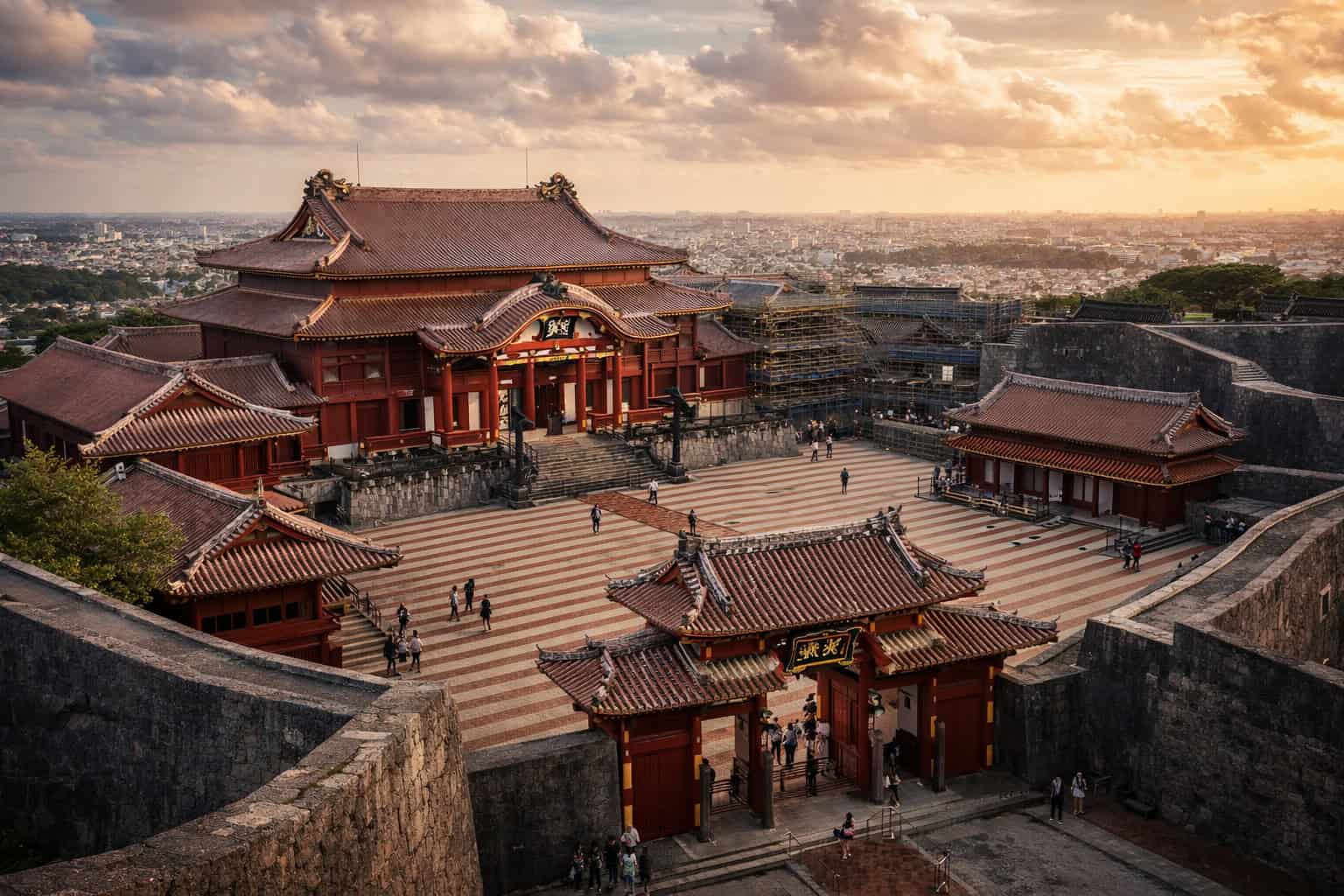
Shuri Castle Okinawa Guide (2026): Reconstruction Update, What You Can Actually See, and How to Visit
Shuri Castle Okinawa is one of the most meaningful places to visit in Naha if you want to understand the Ryukyu Kingdom, see how the castle is being rebuilt, and add real cultural depth to an Okinawa trip that might otherwise revolve only around beaches and food.
I went into this topic expecting another classic Japanese castle guide. Instead, the deeper I looked, the more Shuri Castle felt like something different entirely: not just a defensive stronghold, but a royal stage for diplomacy, ceremony, and identity. That difference is exactly why it stays with people.
Search Intent
Travelers searching for Shuri Castle Okinawa usually want four things at once: a clear explanation of the Ryukyu Kingdom, an honest update on what can actually be seen after the 2019 fire, practical access tips from Naha, and a realistic sense of whether the site is still worth visiting while reconstruction continues. This guide answers all four in one place.
Quick Summary
- Shuri Castle was the political and ceremonial center of the Ryukyu Kingdom, not a typical mainland war castle.
- The site remains highly worth visiting because the reconstruction itself adds context instead of taking value away.
- Take the Yui Rail to Shuri Station, then expect an uphill walk of roughly 15 minutes.
- Plan around seasonal hours, and aim for morning or late afternoon to avoid Okinawa’s most draining heat.
- Pair the visit with Tamaudun and nearby sacred Ryukyuan sites for a much stronger historical experience.
Why Shuri Castle Matters More Than Most Visitors Expect
Many travelers first place Shuri Castle on an itinerary because it is famous. That is understandable, but it is not the best reason to go. The better reason is that this site explains why Okinawa feels culturally distinct from so much of mainland Japan. Shuri Castle was the center of a kingdom that maintained diplomatic and trade relationships with China, Japan, Korea, and Southeast Asia. That international history is visible in its architecture, ceremonial spaces, and symbolic layout.
When I first started looking into it, I assumed the visit would be mostly about ruined walls and a reconstruction story. What surprised me was how much of the site still communicates a living worldview. The gates, the elevated position, the sacred pathways, and the courtly design all suggest a place built not only for control, but for ritual and prestige. That makes it feel less like a fortress museum and more like a cultural key to Okinawa itself.
What It Feels Like to Walk Through Shuri Castle Today
There is something unusual about arriving at Shuri Castle from modern Naha. One moment you are moving through an active city, and the next you are climbing into a place that feels slower, more ceremonial, and more deliberate. The light often hits the stone and red surfaces in a way that makes the site feel warm rather than severe. Even before you understand the history, the atmosphere tells you this was once a seat of refinement.
The walk begins with the famous Shureimon Gate, which is one of the most recognizable symbols in Okinawa. From there, the path rises through stone walls, broad approaches, and layered gateways. It is not a flat stroll. On a humid day, the slope can catch you off guard. I honestly think this is the small mistake many first-time visitors make: they underestimate both the sun and the incline, especially after arriving from the airport with a full day already planned.
At the same time, that physical rise adds to the experience. The approach feels intentional. You are not simply entering a tourist site; you are ascending into what used to be a royal center. Even with reconstruction ongoing, the site still creates a powerful sense of transition from ordinary city life into a historical landscape
History and Cultural Context: The Ryukyu Kingdom Explained Simply
To understand Shuri Castle, it helps to stop thinking in purely Japanese historical terms for a moment. The Ryukyu Kingdom was a maritime kingdom with its own court culture, its own diplomacy, and its own political world. Shuri Castle functioned as the royal palace and administrative heart of that kingdom for centuries. It was a place of governance, ceremony, tribute, reception, and symbolic authority.
This is why the architecture feels distinct. The bright red lacquer, the Chinese influence in gates and decorative forms, and the ceremonial openness of the spaces all reflect a kingdom that negotiated identity through exchange. In other words, Shuri Castle tells a story of connection. It was not isolated. It stood at the crossroads of regional power and culture.
The site also carries layers of loss and recovery. Shuri Castle was heavily damaged during the Battle of Okinawa in 1945. Later reconstruction helped restore it as a visible symbol of Okinawan heritage. Then, in 2019, another devastating fire destroyed major reconstructed structures, including the main hall. Today, the site once again stands in a period of rebuilding. That cycle of destruction and restoration is not a side note. It is part of the reason the castle feels emotionally important to so many visitors and residents.
Highlights: What to See at Shuri Castle Even During Reconstruction
1. Shureimon Gate
This is the visual icon most people recognize immediately. It is photogenic, historically resonant, and an ideal first anchor point for the visit.
2. The layered gates and stone fortifications
The progression through gates and walls helps visitors understand how the complex was structured. Even without full interior access to a completed main hall, this spatial design tells an enormous amount of the story.
3. Reconstruction viewing and interpretation areas
One of the most distinctive features of visiting now is that you are not just seeing a finished monument. You are seeing a national-scale effort to restore it. That creates a rare “history in progress” dimension.
4. Views over Naha
The elevation gives parts of the site a calm, open perspective over the surrounding city. It is a quiet reminder that this was a political center chosen with intention.
Key Visitor Information
| Location | Naha, Okinawa, Japan |
|---|---|
| Nearest Station | Shuri Station (Yui Rail), then about a 15-minute uphill walk |
| Paid Area Adult Admission | ¥400 |
| Typical Visit Time | 2 to 3 hours |
| Seasonal Hours | Paid area generally opens at 8:30 AM, with closing times varying by season |
| Best Time to Visit | Morning or late afternoon for softer light and a more comfortable walk |
| Current Appeal | Heritage site + reconstruction story + Ryukyuan cultural context |
Cultural Experience: Why the Site Still Feels Alive
Shuri Castle works best when you do not treat it as a checklist stop. It is more rewarding when approached as a gateway into Ryukyuan culture. The site and its surrounding district connect visitors to court music, ritual spaces, sacred geography, royal history, and material traditions such as bingata dyeing. That larger context turns the castle from “something to photograph” into “something to interpret.”
There is also an emotional layer to the current visit. Because the reconstruction is visible, visitors witness a community preserving more than wood and tile. They are preserving continuity. I find that more compelling than a perfectly completed monument with no visible struggle behind it. In practical travel terms, this means the site can be deeply satisfying even before the full restoration is finished.
Travel Tips That Make a Big Difference
Go earlier than you think you need to. This is the single most practical tip. The slope, humidity, and sun can drain energy fast, especially if Shuri Castle is only one stop in a long Naha day.
Wear shoes with grip. This sounds minor, but I always think textured historic sites are better with reliable shoes rather than flat city sneakers, especially after rain.
Do not rush the outer areas. Some visitors focus only on where the main hall stands or will stand. That is a mistake. The approach, walls, gates, and surrounding context are a major part of the experience.
Combine it with nearby heritage stops. This gives the castle a richer narrative arc and helps justify the uphill effort.
How to Visit Shuri Castle from Naha Airport or Central Naha
- Take the Yui Rail from Naha Airport or central Naha toward Shuri Station.
- Exit the station and walk uphill for about 15 minutes.
- If the weather is harsh or your schedule is tight, use a taxi or bus for the final segment.
- Check seasonal hours before you go, especially if visiting late in the day.
- Give yourself time to explore both the atmosphere and the historical interpretation rather than only “ticking off” the landmark.
This is one of the easiest major cultural sites to reach from Naha without renting a car. That convenience makes it especially valuable for short Okinawa stays or first-time visitors who want one strong historical stop without complicated logistics.
Nearby Attractions Worth Pairing With Shuri Castle
- Tamaudun Mausoleum – one of the strongest companion sites if you want a fuller Ryukyuan royal-history experience.
- Sonohyan-utaki Ishimon – a sacred stone gate that adds spiritual context to the castle district.
- Shikinaen Garden – another elegant place to deepen your understanding of Ryukyuan court culture.
- Makishi Public Market – a good contrast stop afterward if you want to shift from heritage to local food and city energy.
Shuri Castle vs Mainland Japanese Castles
| Point | Shuri Castle Okinawa | Typical Mainland Castle |
|---|---|---|
| Primary identity | Royal palace and ceremonial center | Military and feudal defensive stronghold |
| Atmosphere | Diplomatic, courtly, culturally hybrid | Martial, strategic, feudal |
| Visual style | Red lacquer, Chinese influence, ceremonial openness | White plaster, black tile, strong fortification aesthetic |
| Best reason to visit | To understand Ryukyuan identity and living restoration | To explore samurai-era and military history |
Who Should Visit Shuri Castle?
- Travelers interested in Japanese history beyond the mainland narrative
- Visitors who want a culturally serious stop in Naha
- Photographers looking for heritage landscapes and layered stone approaches
- UNESCO-oriented travelers building a Ryukyu heritage itinerary
- First-time Okinawa visitors who want one meaningful non-beach experience
If you only want a completed palace interior and nothing else, you may need to calibrate expectations. But if you care about atmosphere, history, symbolism, and cultural context, Shuri Castle still delivers strongly.
FAQ
Is Shuri Castle still worth visiting after the fire?
Yes. The site remains important because the surviving layout, gates, walls, and reconstruction story still provide a strong cultural and historical experience.
How long do I need at Shuri Castle?
Most travelers should allow 2 to 3 hours, especially if pairing the visit with nearby heritage stops.
Can I reach Shuri Castle without a car?
Yes. It is one of the easiest major cultural sites in Okinawa to reach by public transportation thanks to the Yui Rail and nearby bus access.
What is the hardest part of the visit?
For many people, it is simply the heat and uphill walk rather than the navigation. Bring water and avoid the harshest midday period.
Is Shuri Castle a UNESCO World Heritage Site?
The castle ruins are part of the UNESCO-listed “Gusuku Sites and Related Properties of the Kingdom of Ryukyu,” which helps explain the site’s cultural importance.
What makes Shuri Castle different from other castles in Japan?
Its Ryukyuan royal identity, diplomatic history, red lacquer architecture, and ceremonial design make it feel very different from more militarized mainland castle sites.
Should I visit Shuri Castle on my first day in Okinawa?
Yes, if you want a strong historical introduction to the island. Just avoid scheduling it in the hottest part of the day right after landing if you are already tired.
Explore More Japan Destinations
Official and Authoritative Links
Shuri Castle Map
Final Take
Shuri Castle Okinawa is absolutely worth visiting, even in a period of reconstruction. In some ways, this moment may be one of the most meaningful times to go, because the site does not only show what the Ryukyu Kingdom was. It shows how Okinawa continues to protect what that history still means.
If you arrive expecting a polished, fully finished palace experience, you may need to adjust your expectations slightly. But if you want a visit that combines atmosphere, symbolism, historical depth, and one of the clearest windows into Okinawan identity, Shuri Castle remains one of the strongest stops in Naha.
For me, that is what makes it memorable. Not perfection. Continuity.