Circus Maximus Rome: Is It Worth Visiting or Just an Empty Field?

ITALY · ROME

Circus Maximus Rome Guide: What You Actually See, Best Views, and When to Go

Circus Maximus Rome is one of the largest ancient stadiums in history, where chariot races once defined Roman entertainment, political spectacle, and imperial power.

Search Intent: This guide helps you understand what Circus Maximus actually looks like today, whether it is worth visiting, how long to spend there, where to get the best views, and how to connect it with nearby Rome attractions without wasting time.

Quick Summary
  • Circus Maximus Rome was ancient Rome’s largest chariot-racing venue and could hold around 150,000 spectators in Julius Caesar’s rebuilt version.
  • Today, the main area feels like a long open park, so the experience depends on imagination and historical context.
  • The site is always open as a public space, while the paid Circo Maximo Experience offers AR/VR reconstruction on selected dates and hours.
  • The best views are from the Palatine Hill side, where the stadium shape becomes easier to understand.
  • Visit early morning or sunset for softer light, fewer crowds, and better photos.

Circus Maximus Rome is not just an empty field, even though that is honestly what it may look like at first glance. When I first stood there, I felt slightly disappointed because I expected dramatic ruins like the Colosseum. Instead, I saw a wide green valley, a few visible remains, and traffic moving quietly around the edges. The grass underfoot and the distant hum of traffic make the ancient roar feel both gone and present.

But after a few minutes, the place started to change in my mind. The length of the arena became obvious. The Palatine Hill rose above one side like a natural royal balcony. The silence felt strange because this was once one of the loudest and most emotionally charged spaces in ancient Rome. That contrast is exactly why Circus Maximus is worth visiting.

This guide explains what you actually see today, what you should not expect, where to stand for the best perspective, how to visit efficiently, and whether you should add Circus Maximus to a Rome itinerary if your time is limited. Unlike the vast emptiness here, other ancient sites like the Pantheon can surprise visitors with their remarkably preserved and awe-inspiring interiors. The Circus Maximus was the first and largest stadium in ancient Rome, a chariot-racing venue that once packed the valley between the Aventine and Palatine hills. It gives you history without the crowds, which is a trade-off worth making if you let the space do the work.

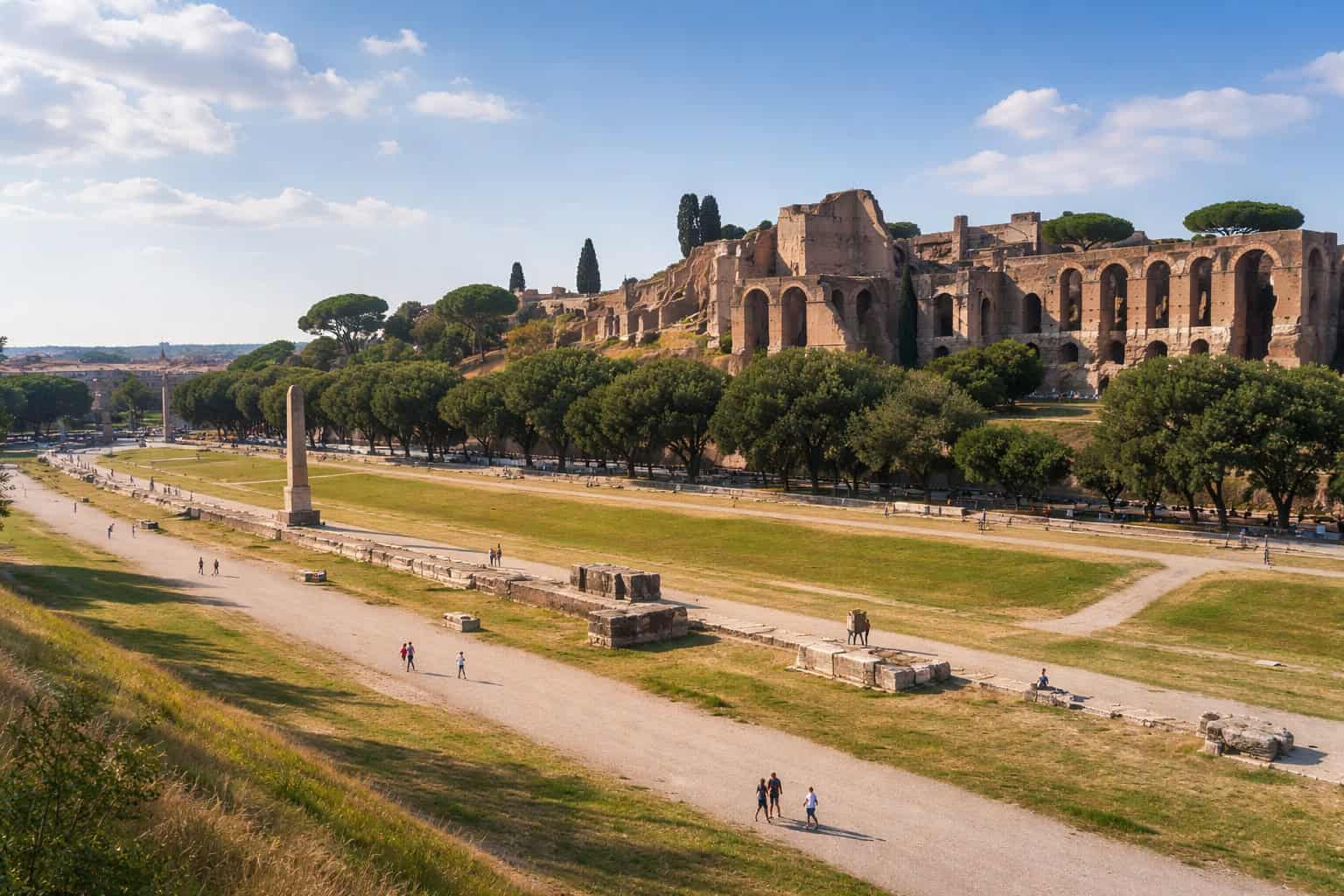
Circus Maximus Rome panoramic view from Palatine Hill
Circus Maximus Rome reveals its true scale from above — once ancient Rome’s largest chariot racing stadium.

Why Circus Maximus Still Matters

Unlike the Colosseum, Circus Maximus does not impress you through preserved walls, arches, and enclosed corridors. Its power comes from scale. Ancient sources and modern reconstructions describe it as one of the largest public entertainment spaces ever built, and Britannica notes that Julius Caesar rebuilt it to seat an estimated 150,000 spectators.

That number matters because Circus Maximus was not simply a sports venue. It was a place where the Roman public gathered, shouted, gambled, celebrated, and watched imperial power turn into public theater. Chariot racing was emotional, dangerous, and deeply tied to popular identity. Teams had colors, supporters had loyalties, and emperors understood that the crowd mattered.

Standing there today, the mistake many travelers make is judging Circus Maximus only by how many ruins remain. If you do that, it may feel underwhelming. If you judge it by what happened there, it becomes one of the most important historic spaces in Rome. The shift happens when you stop looking at the ground and start imagining the valley full.

What Circus Maximus Feels Like Today

Today, Circus Maximus feels more like a vast public park than a conventional archaeological site. You can walk across the long field, look toward the Palatine Hill, and trace the oval-like racing layout with your eyes. There are visible remains, especially around the archaeological area and the Torre della Moletta side, but most of the original monumental structure is gone.

I actually liked this more after lowering my expectations. The site is not trying to overwhelm you with perfect preservation. Instead, it asks you to imagine noise, dust, horses, wheels, shouting spectators, and the political drama of ancient Rome. That slower kind of appreciation is not for every traveler, but it feels rewarding if you enjoy historical atmosphere.

Honest warning: If you only want visually dramatic ruins, Circus Maximus may feel too empty. If you enjoy scale, history, and quiet viewpoints, it becomes much more memorable.

History & Cultural Context

The Circus Maximus sits in the valley between the Palatine and Aventine hills, a location connected with Rome’s earliest legends and public gatherings. Turismo Roma describes it as the largest building for public entertainment in antiquity, measuring about 600 meters long and 140 meters wide. The valley was used for races from the time of Rome’s early kings, while a more formal walled circus developed under Julius Caesar.

The stadium was later rebuilt and expanded by emperors, especially under Trajan, and it remained active into the early 6th century. Over time, the area changed completely. It became agricultural land, later hosted industrial structures, and eventually returned to public and archaeological use.

One detail I found especially helpful is the idea of the spina, the central divider around which chariots raced. It was not just a plain wall. It could include monuments, statues, fountains, and obelisks, turning the racetrack into a moving stage of imperial symbolism.

Main Highlights at Circus Maximus Rome

1. The Long Arena Shape

The most important thing to see is the shape itself. Walk from one end to the other and notice how long the racing space is. This is when the site stops feeling like a random field and starts feeling like a stadium. The length only reads once your legs start measuring it.

2. Palatine Hill Viewpoint

The Palatine Hill side gives the strongest visual context. From higher ground, you can understand the full length of Circus Maximus and imagine the seating rising around the track. It also offers spectacular views of the nearby Roman Forum. This is also one of the best photo angles. The slope works the legs in a way that makes the view feel earned.

3. Torre della Moletta and Archaeological Area

The medieval Torre della Moletta and the nearby archaeological area help visitors see more than grass. Turismo Roma notes that the renovated area includes galleries, ancient paving stones, rooms once used as shops or offices, and a panoramic viewpoint over the site. The old shop floors make the empty field feel like a working street again.

4. Circo Maximo Experience

For travelers who struggle to imagine ancient ruins, the Circo Maximo Experience can be useful. It uses augmented and virtual reality to reconstruct the Circus through different historical phases. The official experience describes a 40-minute walking itinerary with immersive glasses and audio, including stops covering the archaic valley, imperial Circus, seating tiers, shops, medieval phase, and panoramic view. The experience helps bridge the gap between the empty field today and the venue that once held chariot races in the valley between the Aventine and Palatine hills. It asks for forty minutes of your time and gives back a whole vanished city.

Key Visitor Information

Item Details
Main Public Area Always open as a public outdoor space
Entrance Fee Free for the open park area
Paid Experience Circo Maximo Experience AR/VR tour, ticketed separately
Location Between Palatine Hill and Aventine Hill, Rome
Nearest Metro Metro B – Circo Massimo
Best Time Early morning, golden hour, or shortly before sunset
Recommended Time 30–60 minutes for the open site, longer with AR/VR or nearby attractions

Cultural Experience: How to Understand the Site

The best way to experience Circus Maximus is to slow down. Do not rush through it as a quick photo stop. Start near the Circo Massimo metro side, walk along the field, then look back toward the Palatine Hill. Try to imagine seating tiers surrounding the valley and the central racing barrier running down the middle.

What surprised me most was the emotional contrast. The Colosseum feels heavy because the structure surrounds you. Circus Maximus feels heavy because the missing structure forces your imagination to work. That may sound subtle, but it gave me a deeper sense of Rome as a living city layered over ancient remains. The mind strains first, then the stillness takes over.

Travel Tips from Real Experience

Tip 1: Do not expect Colosseum-style ruins.
The most common disappointment comes from expecting walls, tunnels, and dramatic interiors. Circus Maximus is mainly about scale, atmosphere, and context.
Tip 2: Go to the Palatine Hill side for better photos.
Ground-level photos can look flat. Higher angles make the stadium shape much clearer.
Tip 3: Pair it with nearby sights.
Circus Maximus works best when combined with Palatine Hill, the Roman Forum, Aventine Hill, or the Baths of Caracalla.
Warning: Summer heat can be brutal.
There is limited shade across the open field. Bring water, sunglasses, and a hat if visiting from late morning to afternoon.
My mistake:
I first visited too quickly and almost dismissed it. The second time, I walked slower, looked from the Palatine side, and finally understood why the place matters.

How to Visit Circus Maximus Rome

  1. Arrive at Circo Massimo Metro Station. This is the easiest public transport option and places you close to the main open area.
  2. Walk through the central field. Use this first walk to understand the length of the ancient arena.
  3. Move toward the Palatine Hill side. This gives you the best visual relationship between the stadium and imperial Rome.
  4. Look for the archaeological area. If available during your visit, this helps add physical context to the open space.
  5. Continue to Aventine Hill or the Roman Forum. Both pair naturally with Circus Maximus and make the visit feel more complete.

Nearby Attractions to Combine with Circus Maximus

  • Palatine Hill: Best for understanding the imperial setting above the Circus.
  • Roman Forum: Ideal if you want a full ancient Rome itinerary.
  • Aventine Hill: Quieter, scenic, and good for sunset walks.
  • Baths of Caracalla: A strong pairing if you want another large-scale ancient site.
  • Colosseum: Best combined if you want contrast between preserved architecture and open archaeological space.

Circus Maximus vs Colosseum

Feature Circus Maximus Colosseum
Main Use Chariot racing and mass public events Gladiatorial games and arena spectacles
Visual Impact Subtle, open, atmospheric Immediate and dramatic
Crowds Usually lighter Usually very crowded
Cost Free for the public open area Paid ticket required
Best For History lovers, walkers, photographers, low-budget travelers First-time visitors, architecture fans, iconic Rome photos

Who Should Visit Circus Maximus?

Visit Circus Maximus if you enjoy ancient history, free attractions, open-air walks, photography, and quieter places near major Roman landmarks. It is also excellent if you want to understand how entertainment and politics worked together in ancient Rome.

You may skip it if you have only one day in Rome and want only the most visually preserved monuments. In that case, the Colosseum, Roman Forum, Pantheon, and Vatican may feel more rewarding.

For me, Circus Maximus is not a “must-see first” attraction. It is a “do not misunderstand it” attraction. Once you know what to expect, it becomes much more meaningful.

FAQ

Is Circus Maximus Rome worth visiting?

Yes, Circus Maximus is worth visiting if you understand that it is mainly an atmospheric historical site rather than a fully preserved ruin. It is especially rewarding for travelers interested in ancient Rome, photography, and free attractions.

Is Circus Maximus free?

The main open public area is free. However, special experiences such as the Circo Maximo Experience are ticketed separately.

How long should I spend at Circus Maximus?

Most visitors need 30 to 60 minutes. If you add the AR/VR experience, nearby viewpoints, or Palatine Hill, allow more time.

What can you actually see at Circus Maximus today?

You can see the long open arena shape, parts of the archaeological area, the Palatine Hill backdrop, and traces that help explain the original racing layout. Do not expect a fully preserved stadium.

What is the best time to visit Circus Maximus?

Early morning and sunset are best. Midday can be hot and visually flat, especially in summer.

Is Circus Maximus near the Colosseum?

Yes. Circus Maximus is close enough to combine with the Colosseum, Roman Forum, and Palatine Hill, especially if you enjoy walking.

Can you visit Circus Maximus at night?

The open area is generally accessible, but the experience is better in daylight or around sunset when you can see the shape, Palatine Hill, and surrounding landscape clearly.

Should I choose Circus Maximus or the Colosseum?

If it is your first time in Rome, choose the Colosseum first. If you have extra time, Circus Maximus adds a quieter and more reflective view of ancient Roman entertainment.

Location

Final Thought

If you skip Circus Maximus Rome, you may not miss the most visually dramatic monument in the city, but you will miss one of its most powerful spaces. It is not about preserved marble. It is about scale, silence, imagination, and the strange feeling of standing where ancient Rome once roared.

Go with the right expectations, visit at the right time, and look toward the Palatine Hill. That is when Circus Maximus stops looking like an empty field and starts feeling like Rome.