
Roamless eSIM Review: Is It Actually Worth It After 60 Days? (2026 Guide)
Roamless eSIM turned out to be one of the few travel tools I kept using after the “test period” was over. I tried it across a 60-day run through China, Vietnam, Laos, and Thailand, and what surprised me most was not the setup speed or the coverage map. It was the fact that I did not feel pressured to burn through a package before a countdown timer killed it.
I used to hate eSIMs. I hated airport kiosks, I hated swapping plastic SIM cards, and I especially hated paying for a “30-day plan” only to waste half of it because my route changed. Roamless felt different. Not perfect, not magical, but noticeably more practical for the way real multi-country trips actually unfold.
What Travelers Usually Want to Know Before Buying Roamless
Search Intent: Is Roamless actually cheaper than regular travel eSIMs? Does it work well when you cross borders often? Is setup easy? Is the app reliable? And is the “no expiry” idea genuinely useful or just marketing fluff?
This review answers all of that from the angle that matters most: not “Can it theoretically work?” but “Does it still make sense when you are tired, jet-lagged, standing in an arrivals hall, and just need maps, WhatsApp, Grab, and a backup connection that does not waste your money?”
Quick Summary
- Best for: travelers visiting multiple countries and hating expiring data packs.
- Biggest advantage: Roamless uses pay-as-you-go credits, so leftover value can still be there for your next trip.
- Real-world performance: strong enough for maps, ride-hailing, messaging, navigation, and general travel use.
- Main weakness: speeds can vary by country and rural areas are still rural areas—this is not a miracle shield against weak local networks.
- Bottom line: for flexible Asia travel in 2026, Roamless feels smarter than fixed-day eSIM packages unless you know you want a single-country, high-data, short-trip plan.
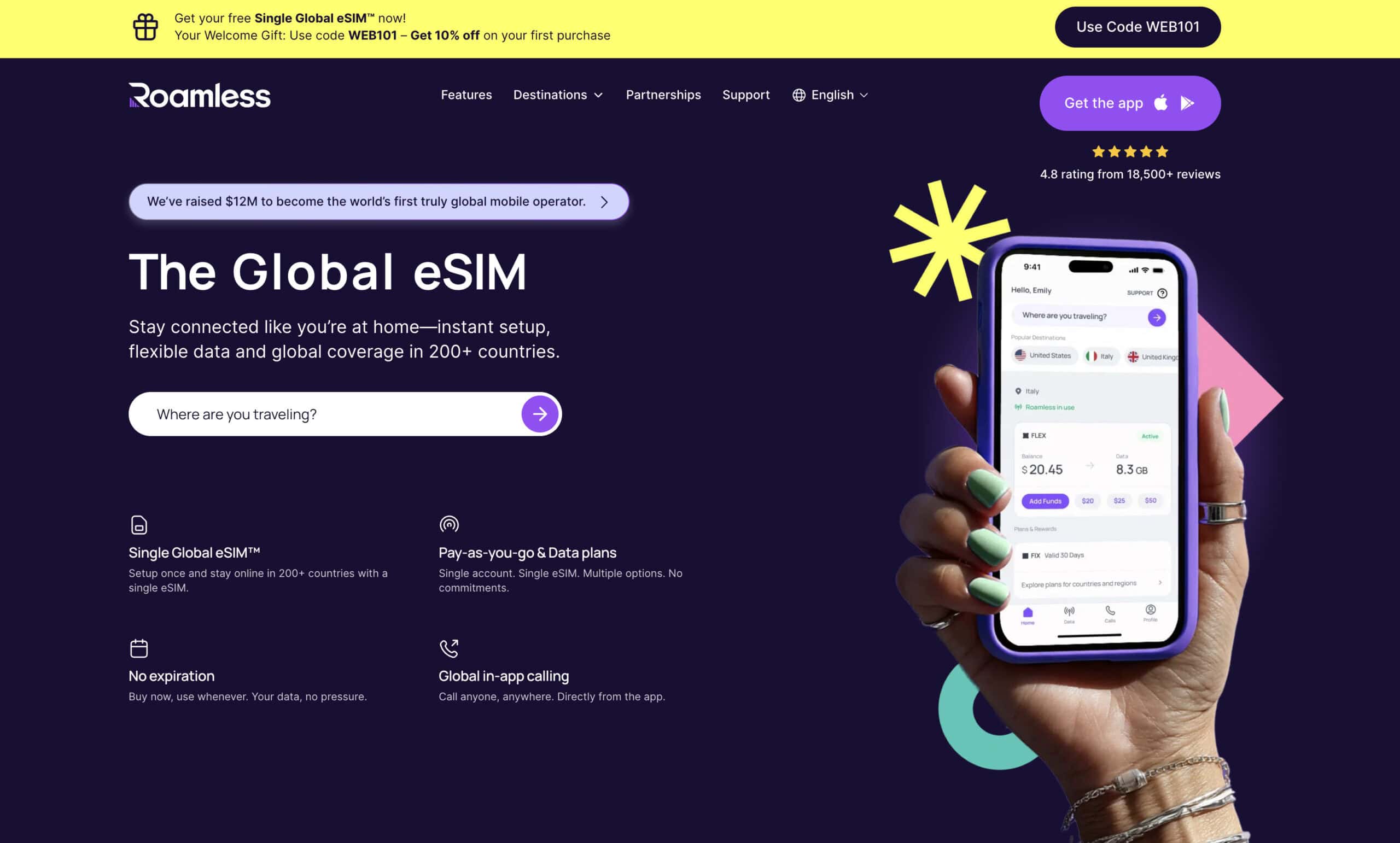
Why Roamless Matters More in 2026 Than It Did a Few Years Ago
Travel connectivity used to be simple: land, find a SIM booth, pay cash, hope the person behind the counter speaks enough English to explain the plan, and pray your phone tray does not disappear into the airport floor. In 2026, the problem is different. There are now too many eSIM options, too many regional packages, and too many plans built around ideal trips instead of messy real ones.
Real travel is rarely neat. Your flight gets delayed. You stay three extra days in Hanoi. You end up crossing into Laos sooner than expected. You use much less data than planned because hotel Wi-Fi is decent. Then on another leg, you burn through data faster because you are using Google Maps all day and uploading videos at night. That is exactly where Roamless starts making sense.
What I liked most is that it matches the rhythm of travel better than the rhythm of telecom billing. That sounds dramatic, but when you have crossed a few borders back-to-back, not having to rebuy and reinstall a new package every time becomes a bigger deal than people think.
What Using It Actually Feels Like on the Road
The best way I can describe Roamless is this: it feels like a travel backup brain. It is not flashy. It is not the kind of product that makes you post a screenshot and say “game changer.” It is the kind of thing that quietly removes friction.
In Bangkok, I had data before I even cleared the immigration line. In Hanoi, I did not have to stand around comparing airport prices while carrying a backpack and pretending to understand tourist SIM promos. In Laos, there was one annoying patch where the signal dipped hard and I muttered things I probably should not repeat here, but even then the frustration came from the local network quality, not because the eSIM itself had vanished.
That is the tone of this review: mostly smooth, occasionally imperfect, rarely stressful. And honestly, “rarely stressful” is a huge compliment in travel tech.
The Bigger Shift: Why Pay-As-You-Go eSIMs Feel More Relevant Now
Traditional travel eSIMs usually sell you a fixed amount of data for a fixed number of days. That model still works fine for very predictable trips. If you are going to Tokyo for exactly five days and know roughly how much data you use, great. Buy the package and move on.
But if you are doing a longer Asia route, bouncing between countries, or planning with any amount of flexibility, fixed packages start to feel wasteful. You either overbuy data “just in case,” or you underbuy and end up topping up through a second purchase. Roamless pushes against that by letting you top up credits and spend them as needed instead of tying everything to a countdown.
Real Test Results: Coverage, Pricing Mindset & Travel Experience
Key Buyer Info at a Glance
Where Roamless Helps Most in Real Travel Situations
The magic is not “internet exists.” The magic is in very specific moments: landing late at night and opening your hotel pin without panic, checking immigration info in transit, calling a ride before the taxi negotiation starts, or translating a menu when the restaurant has no English signage.
I especially noticed the value in those in-between moments that do not show up on marketing pages: switching cities, sitting on a station platform, trying to confirm whether your payment app works, or figuring out if the transport counter has already closed. Roamless is strongest when the trip feels slightly chaotic.
25 Active Days on the Road: What Actually Happened
Mobile data is not a luxury when you are trying to work out whether your driver is taking the long way, whether your gate changed, or whether your guesthouse actually sent the correct location. During the most active 25 days of my trip, Roamless became less of a “travel extra” and more of a small operational safety net.
The FLEX Idea: Why I Did Not Feel Rushed
The best part of the FLEX-style credit model is psychological as much as financial. With regular packages, you start doing weird math in your head: “Should I save this data? Should I wait for Wi-Fi? Am I wasting the final week?” With Roamless, I felt noticeably less defensive about using data when I needed it.
- Referral bonus: small perk, but still useful when you are stacking small travel expenses all month.
- China test: mostly dependable in the places where travelers actually spend time, with predictable variation by local network conditions.
- Leftover value: this is the piece that changed my opinion. Finishing a trip with usable credit left felt much better than “unused data expires tomorrow.”
“I’ll be honest—there was one dead zone in rural Laos where I wanted to launch my phone into the trees. But for the overwhelming majority of the trip, Roamless felt stable enough that I stopped thinking about it. That is probably the highest praise I can give a travel eSIM.”
And that is really the theme here: not perfection, but low-drama usability.
Travel Tips: 5 Things I’d Tell a Friend Before Using Roamless
- Install it before you fly. I mean at home, on stable Wi-Fi, while you are calm. Airport Wi-Fi is where good intentions go to die.
- Turn off roaming on your home SIM. I once got burned by a tiny background update that turned into an absurd bill. That mistake hurts once and stays with you forever.
- Take screenshots of your QR code and activation details. Do not trust the airport to provide a smooth online experience when you need it most.
- Carry a power bank. Dual-SIM behavior and constant navigation can chew through battery faster than you expect.
- Do not expect rural miracles. Roamless can only work with the local networks available. In remote areas, your expectations should stay realistic.
How to Set Up Roamless Without Making Your Trip Harder
- Check phone compatibility before buying anything.
- Install the eSIM at home while you have reliable internet.
- Save screenshots of the QR code, app login, and support info.
- Keep your primary number settings straight so calls/SMS do not accidentally use the wrong line.
- Activate data roaming on the eSIM line only if instructed and confirm your phone is pulling data from the correct profile.
- Test it before departure if possible, so you are not troubleshooting with one bar of airport Wi-Fi and zero patience.
Roamless vs Airalo vs Holafly: My Honest Pick
Who Should Buy Roamless — And Who Probably Shouldn’t
Buy Roamless if you are:
- traveling through two or more countries on one trip,
- tired of expiring data packages,
- the kind of traveler who changes plans mid-trip,
- more concerned with practical reliability than flashy promises.
Skip it if you are:
- doing one short trip to one country and just want the cheapest fixed option,
- expecting perfect rural signal everywhere,
- planning to use it like a replacement for strong hotel Wi-Fi and full-time laptop hotspotting in remote areas.
FAQ: Questions Travelers Ask Before Buying
Is Roamless actually cheaper than Airalo or Holafly?
Not always on every route. The better way to think about it is value over time. Roamless often feels cheaper for flexible travelers because leftover credit still matters later, while fixed-validity plans can become waste if your trip changes.
Does Roamless work well for Southeast Asia?
Yes, that is one of the strongest use cases. It makes the most sense when you are moving between countries like Thailand, Vietnam, Laos, and nearby destinations without wanting a new eSIM purchase every time.
Can I use Roamless for Grab, maps, boarding passes, and messaging?
Absolutely. That is exactly where it felt strongest in my test. It handled the practical travel stack well: navigation, transport apps, ride-hailing, OTP reception workflows, and general communication.
Is Roamless safe enough for banking or sensitive logins?
I still would not treat any travel data connection casually for sensitive banking. Use a trusted device, enable two-factor authentication, and consider a VPN if you are doing anything important.
What happens if my credit runs out mid-trip?
You top up and continue. That is one reason the system feels less stressful than fixed packages. It behaves more like a travel wallet than a countdown timer.
What is the biggest downside of Roamless?
It still depends on local partner networks, so weak regions will still feel weak. Also, travelers who want a super simple short single-country plan may find fixed packages easier to price at a glance.
Helpful Related Guides on Trip Nexus
Official Links
Final Verdict: Is Roamless Worth It?
Yes—if you travel the way many people actually travel: loosely planned, across more than one country, with a strong dislike for wasted data and unnecessary friction. Roamless is not the cheapest answer in every single scenario, and it is not immune to weak local coverage in remote areas. But for practical, flexible travel in 2026, it is one of the smartest eSIM choices I have tested.
I would personally choose it again for another multi-country Asia trip without hesitation. That alone says a lot.
Author Note: This version keeps the honest real-travel tone on purpose. Roamless is not being presented as “perfect.” It is being presented as the eSIM that made the fewest annoying demands on me during a long, flexible trip—and that is exactly why it earned a permanent place on my phone.