Notre-Dame Cathedral Paris Guide: Best Viewpoints, Sunset Spots, and How to See It Right
Notre-Dame Cathedral Paris is one of those places that almost feels too famous to surprise you. Everyone knows the façade, the towers, and the island setting. But the real experience is not a single front-facing photo from the busiest part of Île de la Cité. It is the slow build of perspectives around the cathedral: the buttresses from behind, the river angles at dusk, the quieter Left Bank sightlines, and the way the cathedral changes character depending on light, crowd level, and where you stop.
I think Notre-Dame is most rewarding when you treat it as a viewpoint journey rather than a checkbox monument. If you only stand in front, take one photo, and leave, you miss the real magic. If you circle the island, pause at the right gardens, and time your visit well, the cathedral starts feeling bigger, stranger, and much more alive than the postcard version.
Search Intent
This guide is for travelers who want the best Notre-Dame Cathedral Paris viewpoints, current visitor basics, the smartest photo timing, nearby pairings on Île de la Cité, and a calmer, more memorable visit than the standard “arrive, look, leave” approach.
Quick Summary
- The best Notre-Dame views are not only from the front plaza. The apse, bridges, and Left Bank angles are often more rewarding.
- Early morning is best for lower crowd pressure; golden hour is best for warmth, texture, and atmosphere.
- Square Jean XXIII and Square Viviani are two of the most useful lower-stress viewpoint zones.
- Sainte-Chapelle and the Conciergerie make the strongest half-day pairings nearby.
- Notre-Dame entry is free, but the cathedral recommends using only its official reservation system and warns against fake paid tickets.
Why Notre-Dame feels bigger than one monument
Notre-Dame is powerful because it is both a building and a landscape anchor. It sits on Île de la Cité in a way that lets the city frame it from almost every direction. Bridges, embankments, gardens, and nearby squares all create different readings of the same cathedral. The front façade feels iconic and formal. The rear side, with the flying buttresses, feels more Gothic and architectural. The river views feel cinematic. The interior feels devotional and vertical.
That is why a smarter visit matters. I think people sometimes underestimate how much the cathedral’s emotional effect depends on where they stand. If you only give yourself ten minutes in the busiest zone, Notre-Dame can feel crowded and obvious. If you give yourself an hour or two and move around it, the cathedral starts to reveal more complexity: scale, stone texture, geometry, and an atmosphere that shifts with every angle.
What it feels like on the ground
The atmosphere changes fast depending on which side of the cathedral you are on. In front, the energy is public, crowded, and photo-driven. Behind the apse, the mood becomes quieter and more contemplative. On the riverbanks, the building starts feeling almost theatrical, especially when the Seine catches the last light of the day. On the Left Bank, Notre-Dame looks slightly more distant and balanced, which often makes it easier to photograph cleanly.
I think this is what makes the site so satisfying: it rewards movement. You are never just “done” with one angle. You round a corner, cross a bridge, or step into a garden and suddenly the cathedral changes personality. That sense of rediscovery is what separates a memorable visit from a rushed one.
The mistake many travelers make is arriving at the most obvious viewpoint at the worst time: midday, peak crowds, harsher light, and less patience. Notre-Dame is much kinder to early risers and late walkers. It becomes softer, slower, and more photogenic when you stop fighting the busiest window.
Quick visitor info
| Location | Île de la Cité, Paris |
| Official cathedral hours | Mon–Fri 7:50 AM–7:00 PM, until 10:00 PM on Thursdays; Sat–Sun 8:15 AM–7:30 PM; last entry 30 minutes before closing |
| Entry | Free; official site recommends reserving only through official channels and warns against fake paid tickets |
| Best photo time | Early morning or about one hour before sunset |
| Best low-crowd window | Weekday mornings |
| Nearby pairings | Sainte-Chapelle, Conciergerie, Left Bank river walk |
| Transport | Check RATP for live routes and station updates |
History and context that make the visit better
Notre-Dame is not just famous because it is old. It matters because it sits at the center of so many versions of Paris: medieval, religious, political, literary, and modern. Paris tourism sources now frame the cathedral’s reopening to the public in late 2024 as part of its continuing role as a symbol of resilience for both locals and visitors.
That long continuity is why the building feels emotionally heavy even if you are not especially religious. You are looking at a place that has absorbed centuries of worship, crisis, restoration, and public imagination. It is both sacred site and civic symbol. The best viewpoints help you feel that scale more clearly than the busiest frontal shot ever could.
I find that the cathedral becomes easier to appreciate when you stop trying to “summarize” it in one image. Notre-Dame is not a one-frame monument. It is a sequence of details: portals, tracery, buttresses, towers, river reflections, interior light, and surrounding streets.
Best viewpoints around Notre-Dame Cathedral Paris
1. Square Jean XXIII behind the apse
This is one of the best places to understand the cathedral structurally. The rear side gives you a much richer look at the flying buttresses and the Gothic logic of the building. It also tends to feel calmer than the frontal forecourt area.
2. Square Viviani on the Left Bank
This is one of the most useful quieter viewpoints. It gives you distance, a more balanced composition, and a break from the densest tourist flow. For travelers who want a less obvious photograph, this is one of the strongest picks.
3. Seine bridges and riverbanks
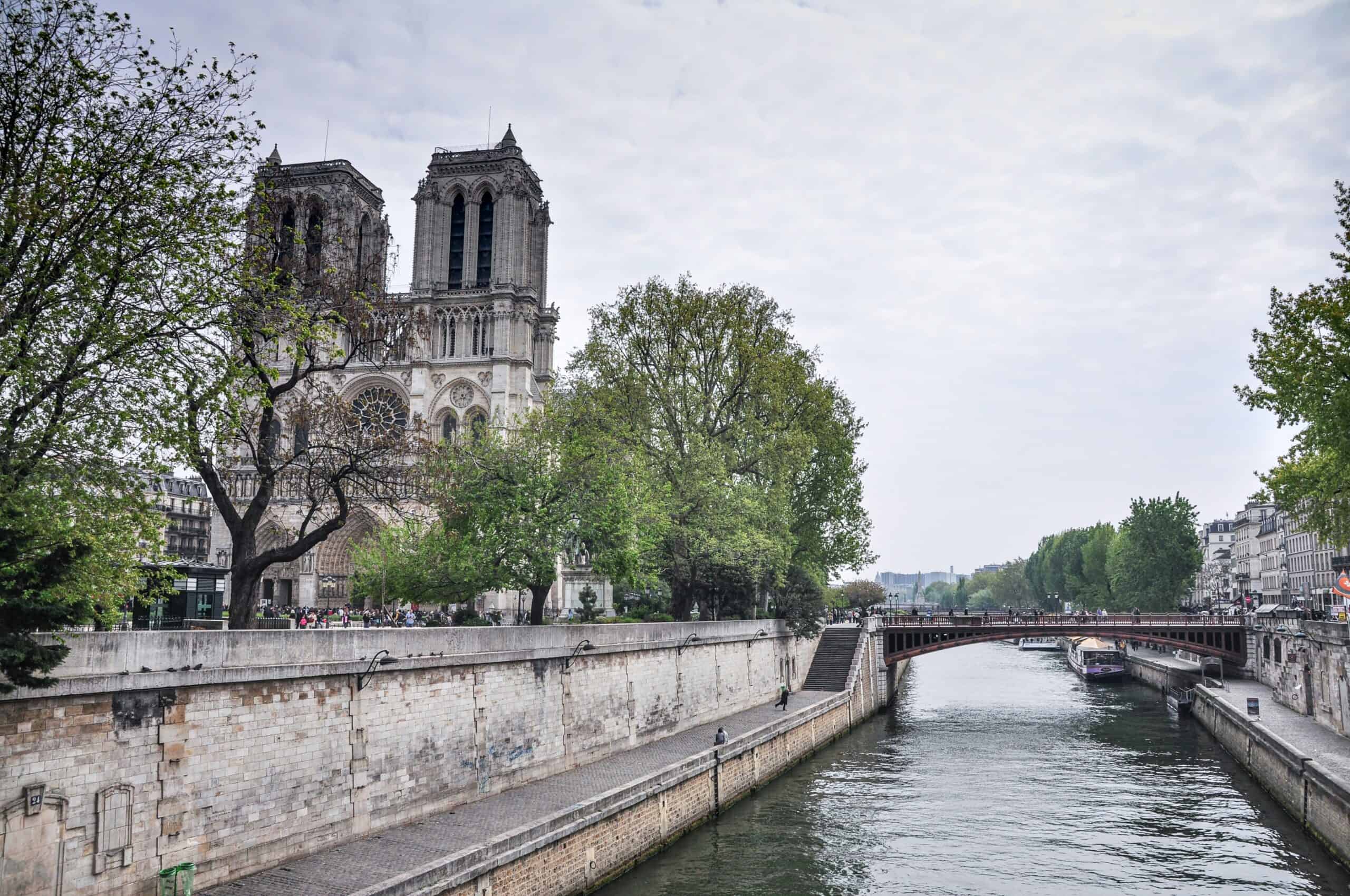
Bridges around Île de la Cité are ideal for classic Paris compositions because they combine water, skyline, and cathedral silhouette in one frame. I especially like these at dusk, when the light softens and reflections begin to matter more.
4. Rooftop terraces farther back in the city
For a broader Paris skyline composition, rooftop terraces such as the better-known department store terraces can work well, though they are less intimate and more panoramic. They are better if your goal is city context rather than architectural detail.
My favorite strategy is to avoid the direct front late in the day and instead work the edges: riverbanks, side bridges, and the quieter garden angles. These places give you more breathing room and better compositions. Sunset does not mean you need the “main spot.” It usually means the opposite.
Bring a light layer if you plan to stay into dusk. The Seine corridor can feel cooler than expected, even after a warm afternoon.
Inside Notre-Dame: what changes once you step in
The interior and treasury are accessible, according to the official cathedral information, and the visitor route has been redesigned after reopening to help visitors better understand the building and its religious meaning.
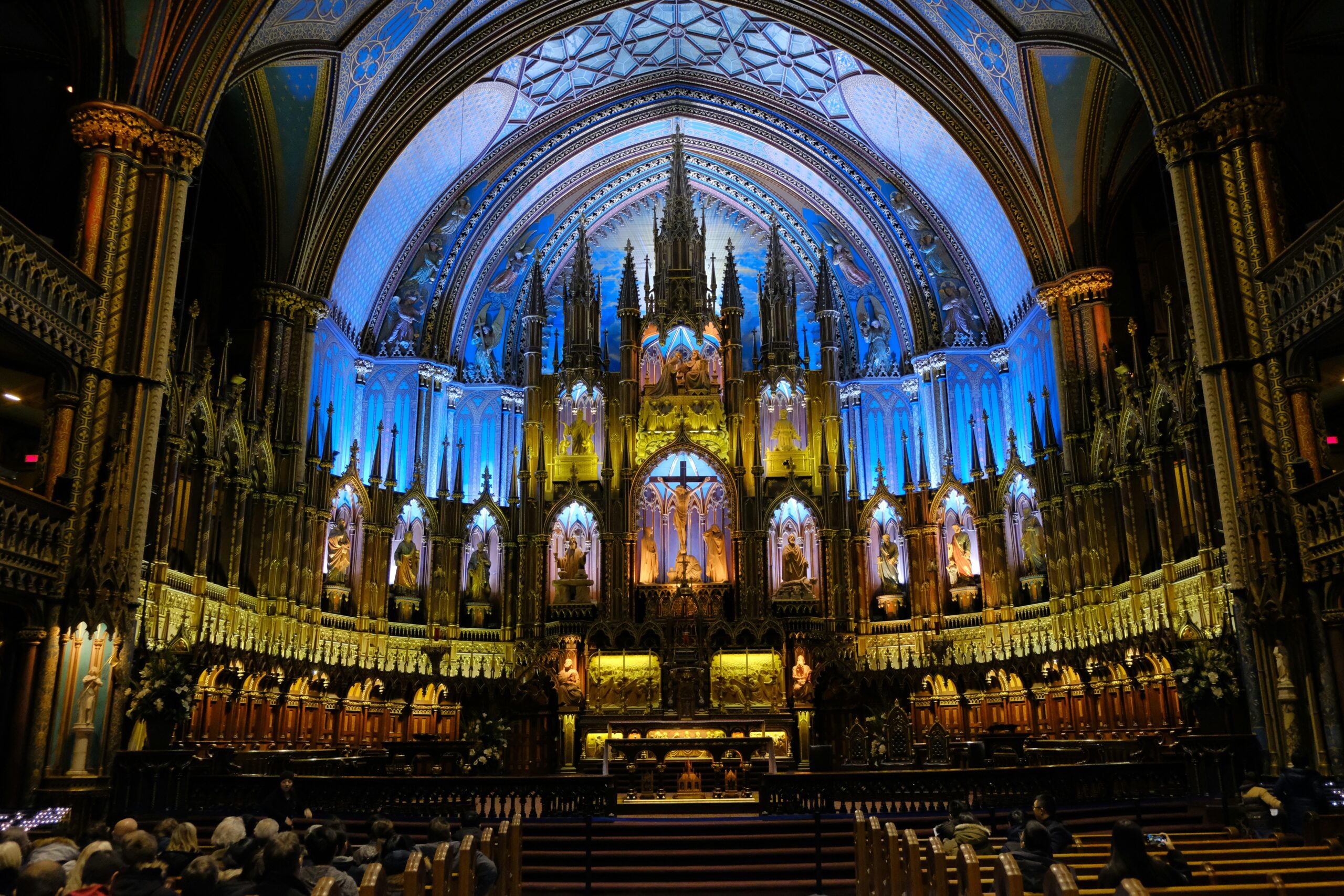
Inside, the experience shifts from viewpoint hunting to vertical immersion. The space feels quieter, more controlled, and more devotional than the exterior promenade. This is where symmetry, height, and filtered light take over. Even travelers who are more interested in architecture than religion usually feel the emotional shift.
I would not rush the interior simply because the outside viewpoints are good. The two experiences do different work. Outside, Notre-Dame is a city object. Inside, it becomes a spiritual and architectural volume.
Photography tips that actually help
- Shoot early or late. Midday flattens stone and creates harsher contrast.
- Go wide first, then detail. Establish the whole building before chasing carvings and structural features.
- Use bridges and embankments as leading lines. They naturally direct the eye toward the cathedral.
- Do not fight for one crowded tripod spot. Slightly off-axis positions usually produce more personal images anyway.
- For interior shots, slow down. The best effect often comes from symmetry and patience, not from taking many images quickly.
Best nearby pairings on Île de la Cité
Sainte-Chapelle and the Conciergerie are the strongest nearby pairings if you want to turn Notre-Dame into a half-day historical route rather than a stand-alone stop. Sainte-Chapelle’s practical information currently lists seasonal hours of 9:00 AM–7:00 PM from April through September and 9:00 AM–5:00 PM from October through March, with last access 30 minutes before closing.
The Conciergerie, meanwhile, is useful for travelers who want a more political and judicial layer to the island’s history. Its official information emphasizes transport access, security checks, and the need to allow time for screening because of its Palais de Justice location.
Together, these stops make the island feel much richer than a single cathedral visit. You move from Gothic devotion to royal and judicial history without leaving the area.
Insider tips to avoid crowds and improve the visit
- Go on weekday mornings if your priority is a calmer exterior loop.
- Choose one anchor moment rather than trying to hit every angle at once: sunrise, sunset, or a slow interior visit.
- Keep belongings secure around bridges and the busiest viewpoint zones.
- Do one full circle of the cathedral. It sounds obvious, but many people never see the rear architecture properly.
- Check official updates before going. The official site notes that schedules can change for specific religious periods and events.
Front plaza vs apse garden vs Left Bank view
| Viewpoint | Best for | Feeling | Trade-off |
|---|---|---|---|
| Front plaza | Iconic façade shot, first-time arrival | Public, formal, crowded | Least calm |
| Square Jean XXIII | Buttresses, structure, quieter views | Architectural, reflective | Less instantly iconic |
| Square Viviani / Left Bank | Balanced composition, calmer photos | Relaxed, scenic | Slightly farther away |
FAQ
Is Notre-Dame Cathedral Paris free to enter?
Yes. The official cathedral site says admission is free and warns visitors to use only official reservation channels.
What is the best time to photograph Notre-Dame?
Early morning is best for calmer light and fewer people. Late afternoon and the hour before sunset are best for warmth and atmosphere.
Where is the quietest good viewpoint?
Square Jean XXIII and Square Viviani are two of the most useful quieter spots, especially compared with the main front area.
Can I combine Notre-Dame with Sainte-Chapelle and the Conciergerie?
Yes, and it is one of the best half-day heritage combinations in central Paris. Sainte-Chapelle and the Conciergerie are both very close by.
Do I need to check official updates before visiting?
Yes. The official site notes schedule changes around certain religious periods and special dates, so checking before you go is wise.
Is the interior accessible?
The official cathedral information says the interior and treasury are accessible.
Continue planning your France trip
Official and authoritative links
Notre-Dame map
Final thoughts
Notre-Dame Cathedral Paris is best experienced as a route of perspectives rather than a single fixed stop. When you combine the front, the apse, the bridges, the Left Bank, and the interior, the cathedral becomes much richer than the standard postcard version.
If you slow down, choose one good light window, and let the island guide your movement, you will come away with a much stronger sense of why Notre-Dame still feels so central to Paris.