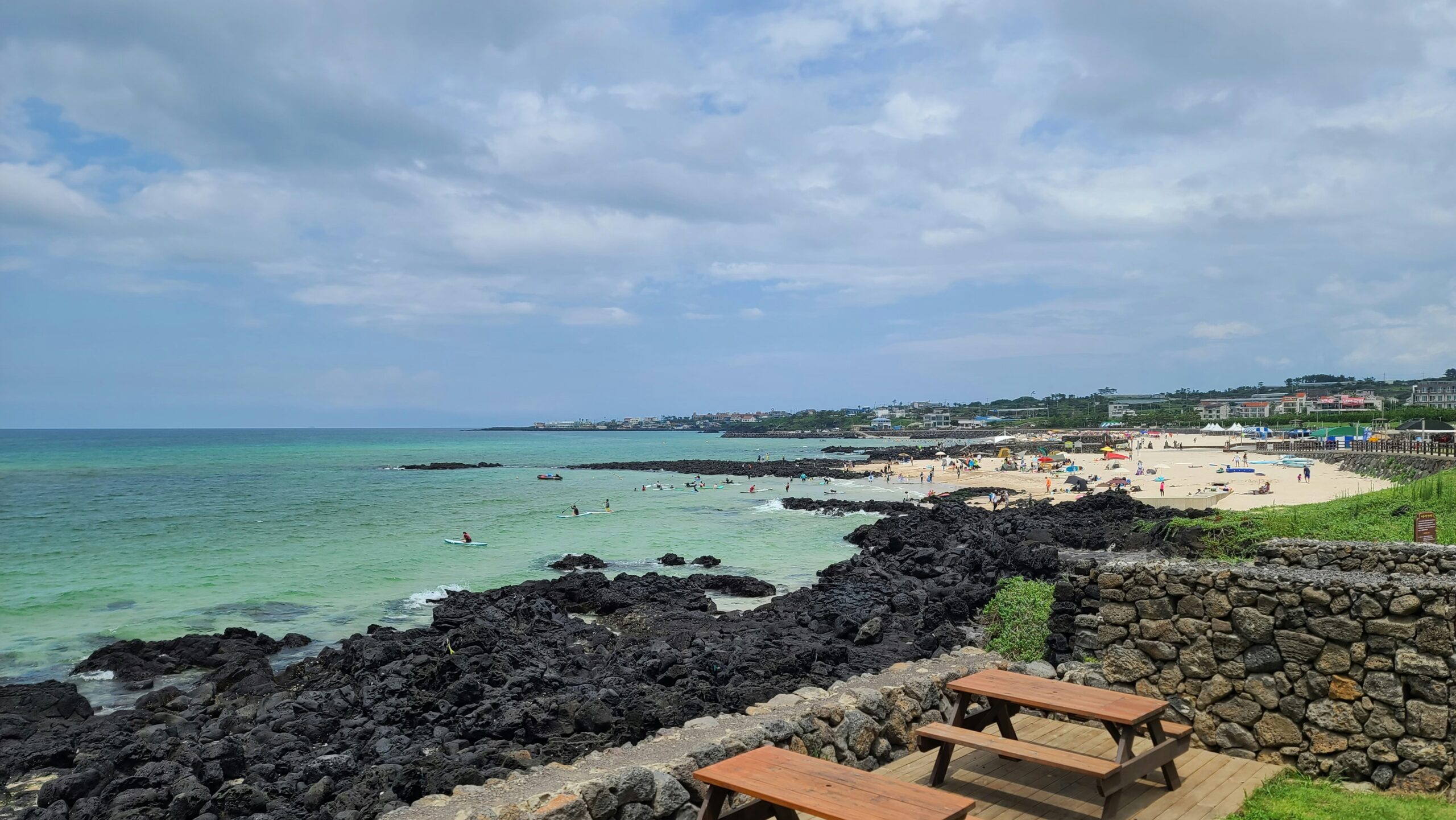
1. The Gateway Coast: Why Iho Tewoo Matters
Iho Tewoo Beach is the Hot-Spot of Jeju City, but its identity is a unique blend of ancient tradition and modern convenience. The “Tewoo” in its name refers to the traditional Jeju flat wooden boat used for anchovy fishing—a nod to the resilient maritime history of the local Iho-dong community.
To understand Iho Tewoo in 2026, one must accept its role as the “Airport Sentinel.” Because of its proximity to Jeju International Airport, the beach serves as a buffer between the high-pressure world of travel and the slow rhythm of the island. It is the definitive “convenience beach.” While other shorelines like Hyeopjae offer pristine white sand, Iho Tewoo offers identity—represented by the twin horse lighthouses that pay homage to the Jeju Pony (Jorangmal).
“
“Standing on the breakwater between the red and white horses, you feel the pulse of Jeju. The roar of a jet engine overhead competes with the steady slap of waves against the concrete blocks. It isn’t the quietest corner of the island, but when the sun drops behind the horizon, the lighthouses glow with a neon intensity that feels both quirky and profoundly welcoming.”
2. Honestly? It’s an Urban Beach with “Jeju Flair”
🔊 The Airport-Zone Confession
The first thing the glossy magazines don’t tell you is the noise. Iho Tewoo is directly in the flight path. Every 10 to 15 minutes, a jet will descend over your head. If you are looking for a silent, meditative sanctuary, this isn’t it. However, if you embrace it as a “dynamic coastal scene,” it’s fascinating. You can literally watch the world arrive in Jeju while you have sand between your toes. Just manage your expectations regarding the acoustic “peace”.
🌊 The Breakwater Safety Reality
Most people rush to the end of the breakwater for the “close-up horse” shot. The Reality Check: The concrete is unshielded from the wind and can be incredibly slippery when wet from sea spray. I’ve seen many travelers struggling with tripods in high gusts. My winning strategy: Wear grippy sneakers and keep your phone secured. The best shot is actually from mid-way down the breakwater, where you can frame both horses together with the harbor entrance.
3. A vs B: The Timing Strategy
In 2026, Iho Tewoo’s popularity is higher than ever. Choosing your window is the difference between a crowded “checklist” stop and a memorable coastal moment.
PRO STRATEGY 2026 Insider Hacks
-
01The “Double-Sided” Sand Strategy
Iho Tewoo has a unique sand composition. One side is fine-grained and white, while the other leans toward volcanic basalt dark. The Hack: Walk the entire curve of the beach to see the “meeting point” of the two colors. It’s a geological signature that most tourists skip while running to the lighthouses. -
02The “Night Pocha” Evolution
In 2026, the area near the harbor becomes a vibrant “Pojangmacha” (tented street stall) zone after dark. The Hack: Don’t just take a photo and leave. Order a bowl of seafood ramen (*Haemul Ramyun*) by the lighthouses at night. The horses are illuminated, and the city lights across the bay provide a 10/10 urban-coastal atmosphere. -
03The Airport Departure Pivot
If you have 2 hours before you need to be at the gate, don’t sit in the airport terminal. Take a taxi to Iho Tewoo. The sea air is the perfect antidote to cabin-pressure stress. You can even check your flight status via the airport Wi-Fi signals that occasionally reach the shoreline edge!.
4. The “Quick-Icon” Route: Step-by-Step
Phase 1: The Tactical Arrival (17:30 PM). If coming from the airport, a taxi is non-negotiable for time efficiency. Tell the driver to drop you at the Iho Harbor side, not the main beach entrance, to save 10 minutes of walking to the lighthouses.
Phase 2: The Golden Hour Stroll. Walk the breakwater while the sun is still 15 degrees above the horizon. This provides the “warm horse” look without the harsh shadows.
Phase 3: The Blue Hour Transition. Stay until the sky turns deep navy. The red lighthouse, in particular, looks incredibly vivid against the dark sea. This is the “editorial” photo window.
Phase 4: The Harbor Bite. Walk 5 minutes to the nearby harbor stalls. Avoid the expensive sashimi restaurants and go for the casual Godeungeo-hoi (raw mackerel) or spicy skewers.
Phase 5: The City Return. Catch a taxi back to your Jeju City hotel or the airport. You’ve just completed the most efficient coastal landmark mission on the island.
5. Geographic Context
6. Expert FAQ: The Honest Clarifications
Optimize Your 2026 Jeju Expedition
7. Expert Final Verdict
Field Data Verified: March 2026 • Curated by the Trip Nexus Jeju Logistics Team.