🔍 Search Intent
This comprehensive guide is for travelers seeking information about Bulgapsa Temple in Yeonggwang, Jeollanam-do. Whether you are coming for the famous Sangsahwa (Spider Lily) Festival, researching the Daeungjeon Hall’s intricate lattice doors, or planning a temple stay to experience authentic Korean Buddhism, we provide the most updated 2026 logistical and cultural details.
Bulgapsa: The “First Temple” Quick Facts
- ✔ Historical Significance: Founded in 384 AD by Monk Marananta; often cited as the first Buddhist temple in the Baekje Kingdom.
- ✔ Must-See Festival: The Sangsahwa (Red Spider Lily) Festival peaks in mid to late September.
- ✔ Treasure Alert: Daeungjeon Main Hall (Treasure No. 830) and the newly designated Four Heavenly Kings (Sacheonwang) statues.
- ✔ Transport: Best reached via intercity bus to Yeonggwang Terminal, followed by local bus 510 or 551.
- ✔ Admission: Free entry to the grounds; parking is plentiful and currently free.
The Living Heart of Korean Buddhist Heritage
Imagine a place where serenity drapes over the land like morning mist, where history pulses with the quiet rhythm of Buddhist chants, and where every stone and pine tree shares a story as old as the hills themselves. I remember my first visit to Bulgapsa Temple—I arrived just as the dawn fog was lifting from Mount Bulgap. The silence was so absolute you could hear the soft thud of a ripe acorn hitting the forest floor. It wasn’t just a destination; it felt like stepping into a ink-wash painting that had come to life.
Nestled in the southwestern corner of the Korean peninsula, Bulgapsa is the jewel of Yeonggwang. For over 1,600 years, this temple has served as a sanctuary. Unlike the bustling, crowded temples of Seoul or Gyeongju, Bulgapsa retains a rugged, earthy honesty. It beckons travelers seeking not only Instagrammable beauty but a deeper connection with the “timeless heritage” that still defines the Korean spirit. Whether you are here for the meditation or the marigolds of autumn, you will leave feeling different than when you arrived.
What It Feels Like on the Ground
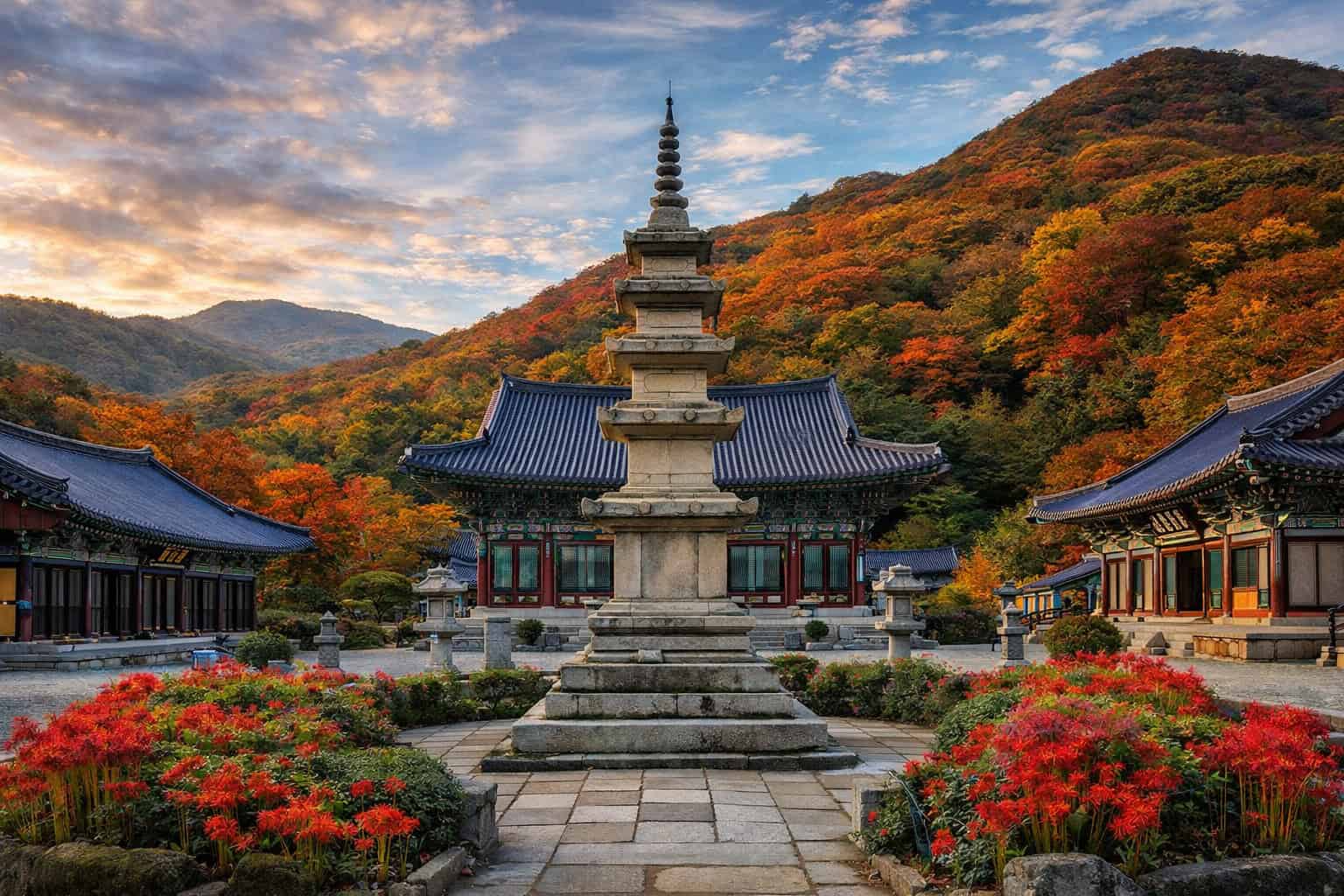
Walking toward the main gate of Bulgapsa feels like a slow, rhythmic transition. The air in Yeonggwang has a specific crispness, often carrying the faint, salty scent of the West Sea mixed with the deep, musky aroma of ancient damp earth. In September, the visual impact is almost overwhelming—a literal “sea of red” as millions of Spider Lilies (Lycoris Radiata) carpet the valley. The contrast between the brilliant crimson petals and the dark, weathered wood of the temple halls is, quite frankly, breathtaking.
I felt a strange sense of perspective standing before the Daeungjeon Hall. You hear the distant, hollow clack of the moktak (percussion instrument used by monks) and the smell of high-quality incense that sticks to your clothes. It’s not just a religious site; it’s a sensory anchor. You find yourself whispering, not because anyone told you to, but because the atmosphere demands a certain level of quiet respect. It is a place that invites you to slow down, breathe, and actually listen to the wind rattling through the bamboo groves.
The Roots of the Baekje Kingdom
To understand Bulgapsa, you have to understand Monk Marananta. In 384 AD, this Indian monk crossed the sea and arrived at Beopseongpo (nearby) to bring Buddhism to the Baekje Kingdom. Bulgapsa was the very first temple he established, which is why its name starts with “Bul” (Buddha) and “Gap” (First/Leader). This isn’t just a local myth; official research by the Cultural Heritage Administration confirms its foundational role in Korean spiritual history.
The architecture reflects this antiquity. The Daeungjeon Hall (Treasure No. 830) is unique because its Buddha statue faces west, unlike the typical south-facing orientations. Why? It reflects a deep-rooted belief in the Western Pure Land. Every time I see the floral lattice patterns on the doors, I am reminded that these weren’t just decorative choices—they were acts of devotion by anonymous craftsmen who believed their work could bridge the gap between the mundane and the divine.
Bulgapsa Visitor Logistics 2026
| Category | Information |
|---|---|
| Location | 450, Bulgapsa-ro, Bulgap-myeon, Yeonggwang-gun |
| Primary Festival | Yeonggwang Sangsahwa Festival (Mid-September) |
| Cultural Assets | Daeungjeon (Treasure 830), Sacheonwang Statues |
| Admission / Parking | Free / Free (Large lots available) |
| Local Specialty | Yeonggwang Gulbi (Dried Yellow Corvina) |
The Rhythm of a Temple Stay
If you want to truly “feel” Bulgapsa, a day trip isn’t enough. I highly recommend the Sangsahwa Temple Stay or the “Happy Travel” program. Rising at 4:00 AM for the dawn chanting might sound like a nightmare, but there is something transformative about standing in the dark, cold hall as the low bass of the temple drum begins to echo through your chest. It’s a literal vibration of history.
During my last stay, I had a conversation with a monk over balwoo gongyang (traditional monastic meal). He told me that “the red spider lilies only bloom because the leaves and flowers never meet.” This legend of longing (Sangsahwa) is the emotional heartbeat of the temple. Participating in 108 bows or lotus lantern making here isn’t just a “tourist activity”—it’s an invitation to mindfulness that is often lost in our 5G-connected lives.
💡 Pro Tip
Visit during the weekday if you’re coming for the flower festival. Weekends are notoriously packed with tour buses, and your “peaceful walk” will turn into a battle for photo spots!
⚠️ Warning
The Daeungjeon Hall is an active place of worship. Avoid taking photos of the monks during their prayers and never walk directly in front of the center Buddha statue.
Bulgapsa vs. Bulguksa: Which to Visit?
Many travelers confuse Bulgapsa in Yeonggwang with the famous Bulguksa in Gyeongju. Here is the ground truth:
Bulgapsa (Yeonggwang)
- Vibe: Serene, rustic, “hidden gem.”
- Highlight: Red Spider Lily festival.
- Best For: Nature lovers, slow travel, spiritual retreats.
Bulguksa (Gyeongju)
- Vibe: Grand, UNESCO site, high traffic.
- Highlight: Dabotap Pagoda, Seokguram Grotto.
- Best For: First-time visitors, history buffs.
Insider Hacks for the Modern Pilgrim
One of my biggest regrets from my first trip was not exploring the Silverleaf Tree (Neolitsea sericea) community. It’s Natural Monument No. 112 and is located just behind the temple grounds. These trees have a haunting, silvery sheen that looks magical in the late afternoon “golden hour.” Most tourists skip this and head straight for the main hall—don’t be one of them. ?
Another “pro” move is to combine your visit with the Baeksu Coastal Road. It is consistently ranked as one of the most beautiful driving roads in Korea. After a morning of spiritual quiet at Bulgapsa, the dramatic sunset over the West Sea at Baeksu provides a perfect emotional counterpoint. I recommend stopping at a cafe called Bori—the sunset view there will change your life, or at least your desktop wallpaper.
The Route to Bulgapsa
1
Gwangju Arrival
Most international travelers start from Gwangju U-Square Terminal (Express Bus).
2
Yeonggwang Intercity Bus
Take the bus to Yeonggwang Terminal (approx. 50 mins). Buses run every 20-30 mins.
3
Local Connection
Find Bus 510 or 551 at the Yeonggwang Terminal platform. Ask for “Bulgapsa-ro.”
4
The Final Walk
Get off at the Bulgapsa stop and walk 10 minutes through the scenic park to the main gate.
Your “Bulgapsa Bound” Checklist
- Modest attire (shoulders and knees covered)
- Comfortable walking shoes (for Mount Bulgap trails)
- Cash for small donations or snacks
- Power bank (signal can be spotty in the valley)
- Handkerchief (to wipe sweat if you hike Mount Bulgap)
- Appetite for Gulbi (local fish)
Official and Authoritative Links
- Bulgapsa Temple Official Website – Current temple stay info.
- Yeonggwang-gun Tourism Office – Festival schedules and local food.
- VISITKOREA – Bulgapsa Entry – General traveler support.
- Cultural Heritage Administration – Technical details on Treasure 830.
Locate Your Zen
Common Questions from Visitors
When is the absolute best time to see the spider lilies?
Peak bloom typically occurs between September 15th and September 25th. However, since the flowers bloom and fade quickly, it’s wise to check the “real-time” bloom status on the Yeonggwang Tourism Instagram or website before your trip.
Is Bulgapsa accessible for seniors or children?
The main path from the parking lot to the temple is flat and paved, making it very accessible. However, once inside the temple complex, there are stone steps and uneven paths. Wheelchairs can access the courtyards, but not the interior of the prayer halls.
Where can I eat Yeonggwang Gulbi near the temple?
There are several traditional restaurants right at the entrance of the Bulgapsa Tourist Site. Look for signs saying “굴비정식” (Gulbi Jeongsik). If you want the “authentic market vibe,” head 20 minutes away to the Beopseongpo area.
Find Your Peace in Yeonggwang
Bulgapsa Temple is more than just ancient buildings—it is a luminous beacon of tranquility. Don’t just read about it; feel the rhythm of the mountains yourself.