Grand Palais Paris Guide (2026): Exhibitions, Glass Nave, Tickets, and What Makes It Truly Worth Visiting
Grand Palais Paris is one of the French capital’s most impressive cultural landmarks, where monumental architecture, major exhibitions, and the theatrical scale of Belle Époque Paris come together in one place. Sitting just off Avenue Winston Churchill near the Champs-Élysées, it feels less like a single museum and more like a vast stage where Paris keeps reinventing itself through art, design, fashion, and public culture.
What makes the Grand Palais special is not simply that it is beautiful. Paris has no shortage of beautiful buildings. The difference here is energy. The iron framework, the enormous glass roof, the changing exhibition calendar, and the sense of national prestige built into the structure all make the visit feel larger than a standard museum stop. Even before you enter, the building announces itself with confidence.
I think this is one of the most rewarding Paris attractions for travelers who want more than a checklist photo. If you are drawn to architecture, temporary exhibitions, grand public spaces, or the feeling of old Paris adapting itself to contemporary culture, the Grand Palais can become one of the most memorable stops on your trip.
Search Intent
This guide is for travelers planning a Paris itinerary who want to know whether Grand Palais is worth visiting, what the experience actually feels like, how the exhibitions work, when to go for fewer crowds, how to get there, and which nearby attractions make the strongest combined route.
Quick Summary
- Grand Palais is one of Paris’s most iconic exhibition venues, famous for its glass nave and Belle Époque architecture.
- It is best approached as a major cultural venue rather than a fixed museum with one permanent display.
- Opening hours are generally Tuesday to Sunday, 09:30 to 20:00, with Friday late opening until 22:30.
- Tickets vary by exhibition or event, so checking the official program in advance matters.
- The building works especially well with Petit Palais, Pont Alexandre III, and the Champs-Élysées on the same day.
- Weekday mornings usually feel calmer, while Friday evenings can feel more atmospheric.
- If you want one Paris landmark that combines architecture, scale, and contemporary cultural life, Grand Palais is a very strong choice.
Why Grand Palais Matters in Paris
Some Paris landmarks are important because of a single masterpiece, a famous royal connection, or one unforgettable view. Grand Palais is different. Its power comes from scale, versatility, and historical ambition. Built for the 1900 Exposition Universelle, it was designed as a national statement. The architecture was meant to prove that France could merge beauty, engineering, and civic prestige in one enormous public monument.
That intention still comes through today. Even if you know nothing about the current exhibition before arriving, the building itself already creates a sense of occasion. The façade is formal and monumental, but the interior atmosphere is what gives Grand Palais its emotional impact. Once you enter, the structure stops feeling static and starts feeling alive.
For travelers, that matters because this is not just a place to “see.” It is a place that changes according to what is happening inside it. That flexibility is one of the reasons Grand Palais keeps attracting both first-time visitors and people who return to Paris often.
What It Feels Like Inside
The first thing I noticed about Grand Palais was not one artwork or one exhibition label. It was the light. The glass roof changes the emotional temperature of the entire visit. Even when the space is busy, the natural light gives the interior a strange openness that many museums do not have.
The second thing is scale. Grand Palais feels ceremonial in a way that many cultural venues do not. You are not just moving through galleries. You feel as if you are moving through a civic monument that happens to host art and events. That makes even temporary exhibitions feel larger and more theatrical.
One honest downside is that expectations can get too vague. If you arrive without checking what is currently on, you may admire the building but miss the best part of the visit. Grand Palais rewards a little planning.
History and Architecture: Why the Building Alone Is Worth It
Grand Palais was created for the 1900 Paris Universal Exhibition, a moment when France wanted to showcase not just national culture but technological confidence. That origin explains why the building feels so unapologetically grand. It was designed to impress from the beginning.
The architectural language is part of the appeal. The exterior keeps a classical monumental dignity, but the interior structure reveals the real ambition: iron, glass, and openness on a vast scale. This combination is exactly what makes Grand Palais feel both historic and surprisingly modern.
For architecture lovers, it is one of the easiest places in Paris to understand the transition between 19th-century grandeur and 20th-century structural confidence. Even if you are not an architecture specialist, the building communicates that shift very clearly once you stand under the glass nave.
Key Visitor Information
| Name | Grand Palais |
|---|---|
| Main address | 17 avenue du Général Eisenhower, 75008 Paris, France |
| Type | Historic monument, exhibition venue, cultural landmark |
| Opening hours | Tuesday to Sunday, 09:30–20:00; Friday late opening until 22:30 |
| Regular closure days | December 25, May 1, and July 14 |
| Tickets | Varies by exhibition or event; advance booking recommended |
| Accessibility | Accessible services available, though details vary by event |
| Best time to visit | Weekday mornings for fewer crowds, Friday evenings for atmosphere |
| Official site | Grand Palais Official Website |
Cultural Highlights and Why Repeat Visits Make Sense
One of the strongest things about Grand Palais is that it does not depend on one permanent collection to justify itself. Instead, it keeps renewing its identity through exhibitions, fairs, installations, performances, and large-format public programming.
That makes it especially attractive for travelers who return to Paris. The building stays the same, but the experience changes. One season may center on major art exhibitions, another on design, photography, performance, or family-friendly cultural spaces.
If you like cultural venues that feel active rather than static, Grand Palais is far more compelling than a landmark you visit once and never think about again.
How to Visit Without Wasting Time
- Check the official program first. Grand Palais is event-driven, so what is on matters as much as the building itself.
- Book online if the exhibition is popular. This matters even more during peak Paris travel periods.
- Choose your timing deliberately. Weekday mornings are the safest for space and pacing, while Friday evenings can feel more cinematic.
- Pair it with nearby landmarks. Petit Palais, Pont Alexandre III, and the Champs-Élysées make the surrounding area highly efficient for itinerary planning.
- Allow breathing room. Do not schedule Grand Palais like a five-minute photo stop. It works best when you can move slowly through the architecture as well as the exhibition.
Practical Tips and Real Visitor Warnings
- Do not assume one fixed ticket rule. Prices and access depend on the current exhibition or event.
- If architecture is your main reason for visiting, try to avoid peak crowd windows so the space can breathe a little.
- Wear comfortable shoes. The area around Grand Palais invites extra walking, especially if you continue toward the Seine or Champs-Élysées.
- Check photography rules for the specific event, not just the building in general.
- Leave time for Petit Palais across the street. Skipping it is one of the easiest missed opportunities in this area.
Tip: Friday late opening can be a smart choice if you want the building to feel more atmospheric and less like a rushed daytime museum visit.
Warning: Do not rely on old renovation-era information. Grand Palais has reopened in stages, and current access, hours, and ticketing are program-based, so always verify the official page before you go.
How to Get There
The Grand Palais is exceptionally well connected, which is one reason it fits so easily into a central Paris itinerary. The nearest metro options are Champs-Élysées–Clemenceau and Franklin D. Roosevelt, while Invalides on RER C is also a practical approach if you are moving along the Seine corridor.
- Metro: Champs-Élysées–Clemenceau (Lines 1 and 13), Franklin D. Roosevelt (Lines 1 and 9)
- RER: Invalides (Line C), then a short walk
- Bus: Multiple central lines stop nearby depending on your route
The area is very walkable, and that is part of the charm. Once you arrive, you are already in one of the easiest high-value sightseeing zones in Paris.
Nearby Attractions Worth Combining
Pont Alexandre III is the obvious companion stop if you want one of Paris’s most photogenic bridge views and a stronger sense of the Seine setting around Grand Palais.
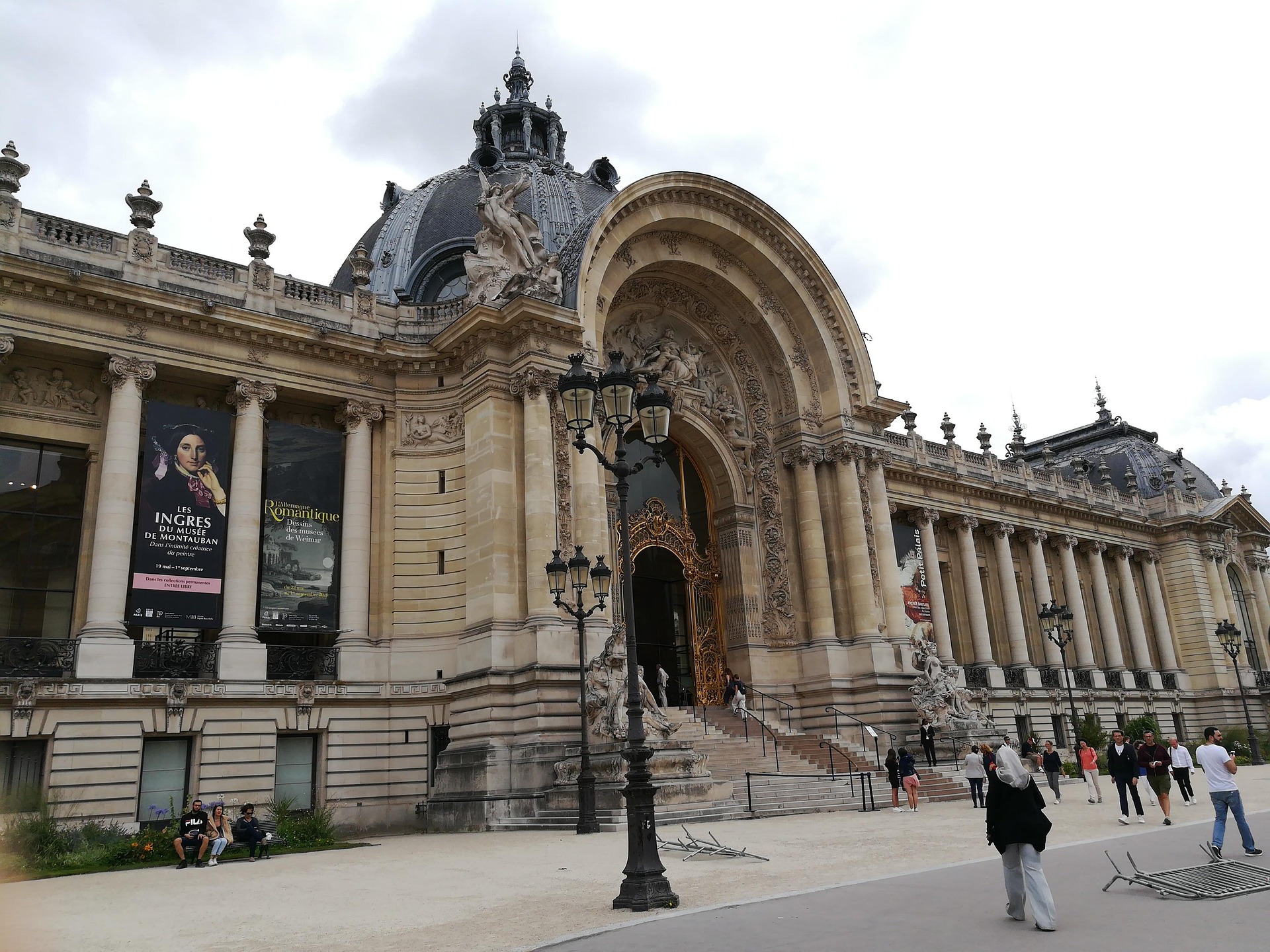
Petit Palais, located directly opposite, is one of the best pairings in the city because it balances the event-driven energy of Grand Palais with a more traditional museum rhythm.
Champs-Élysées adds scale, shopping, cafés, and classic Paris boulevard atmosphere if you want to extend the day beyond culture alone.
Grand Palais vs Petit Palais
| Feature | Grand Palais | Petit Palais |
|---|---|---|
| Main appeal | Monumental architecture + changing exhibitions | Permanent fine arts museum experience |
| Visit style | Program-driven, event-sensitive | More stable and predictable |
| Atmosphere | Grand, theatrical, civic | Elegant, quieter, museum-like |
| Best for | Travelers wanting scale and contemporary cultural energy | Travelers wanting a calmer art visit |
If you can do both on the same day, that is ideal. They complement each other better than most landmark pairings in Paris.
Who Should Visit Grand Palais
- Travelers who love architecture as much as art
- Paris visitors looking for a major landmark beyond the standard museum list
- People who enjoy temporary exhibitions and changing cultural programs
- Visitors building a central Paris day around the Seine and Champs-Élysées
- Anyone who wants to feel the scale of Belle Époque Paris in a living cultural venue
Frequently Asked Questions
Is Grand Palais worth visiting even if I am not an art expert?
Yes. The architecture and scale alone make it worthwhile, and the changing program means there is often something accessible even for casual visitors.
Does Grand Palais have a permanent museum collection?
It is better understood as a major exhibition and event venue rather than a traditional museum centered on one permanent collection.
What are the usual opening hours?
The official current guidance is Tuesday to Sunday from 09:30 to 20:00, with Friday late opening until 22:30.
Should I buy tickets in advance?
Yes, especially for major exhibitions or busy travel periods. The official site recommends online booking.
What is the best nearby museum pairing?
Petit Palais is the strongest pairing because it is directly opposite and offers a very different, more traditional museum atmosphere.
Can I combine Grand Palais with a Seine walk?
Absolutely. The location makes it easy to continue toward Pont Alexandre III, the Seine, Invalides, or the Champs-Élysées after your visit.
Related Trip Nexus Guides
Official Resources
Google Map
Final Thoughts
Grand Palais Paris is one of those rare landmarks that succeeds as both architecture and living cultural venue. It carries historical weight without feeling frozen in the past, and that balance is exactly what makes it so satisfying to visit.
What stayed with me most was not only the beauty of the structure but the feeling that the building still has momentum. It does not just preserve Parisian grandeur. It keeps using that grandeur for new cultural life.
Next step: if you are building a strong central Paris route, combine Grand Palais with Petit Palais, Pont Alexandre III, and a late walk toward the Champs-Élysées for one of the easiest high-impact half-days in the city.