KOREA • JEJU
Seogwipo Maeil Olle Market Guide: What to Eat, When to Go, and Why It’s Better Than Dongmun
Seogwipo Maeil Olle Market Jeju is the vibrant culinary heart of southern Jeju, where local seafood, black pork, citrus, and everyday island life come together under one long market roof.
Search Intent
This guide is for travelers who want to know whether Seogwipo Maeil Olle Market is worth visiting, what to eat, when to go, how crowded it gets, how it compares with Dongmun Market, and how to build a smooth Jeju evening route around it.
Quick Summary
- Best known for black pork snacks, fresh seafood, citrus products, and night-market street food
- Most atmospheric time to visit is late afternoon into evening, especially after many food stalls start heating up
- The market is one of Seogwipo’s oldest and biggest permanent traditional markets
- It is easy to pair with Lee Jung-seop Street, Cheonjiyeon Waterfall, and Seogwipo Harbor
- Compared with Dongmun Market, it feels more relaxed, more walkable, and less overwhelming for first-time visitors
Seogwipo Maeil Olle Market Jeju is one of those places that makes Jeju feel immediate rather than scenic from a distance. The island is famous for lava cliffs, waterfalls, beaches, and Hallasan, but markets like this are where Jeju stops feeling like a postcard and starts feeling lived in. Inside the lanes, you are not just looking at local life. You are moving through it.
When I think back to the market, the first thing I remember is not one specific snack. It is the mix of smells and sounds that hit all at once: sweet Hallabong citrus, smoky grilled meat, raw seafood chilled on trays, older vendors calling customers over, and the steady shuffle of people carrying paper cups, skewers, and takeaway boxes. It feels lively, but not chaotic. That balance is a big part of why the market works so well.
For travelers, this is one of the easiest ways to understand southern Jeju beyond sightseeing. You can taste local ingredients, see what residents actually buy, compare traditional foods with newer street-food trends, and still keep the visit flexible. Some people come only for a snack stop. Others make it the anchor of their Seogwipo evening. Both approaches work, but the market becomes much more memorable when you give it enough time to wander instead of treating it like a ten-minute checklist stop.

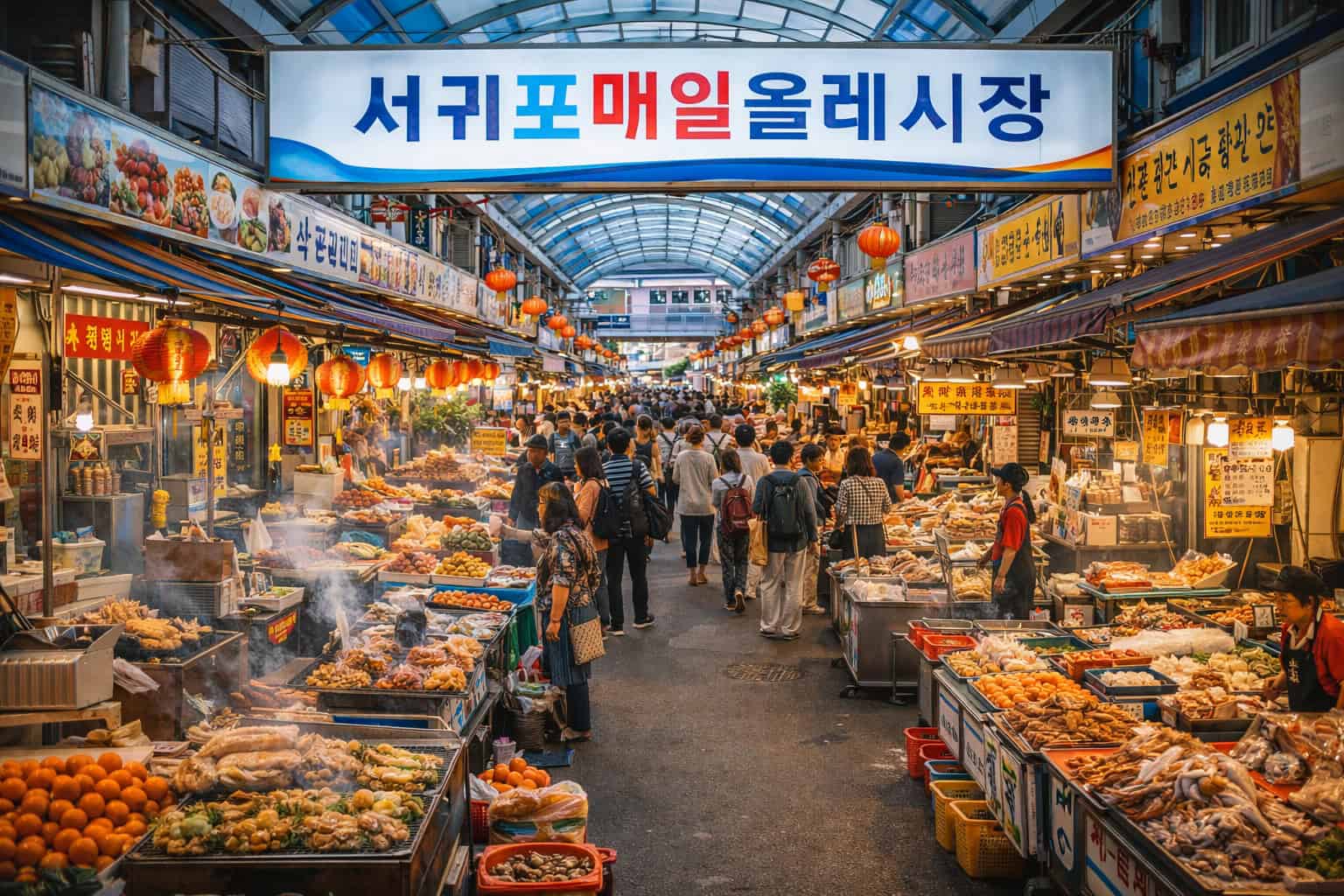
The main covered corridor of Seogwipo Maeil Olle Market gives the market its easy, weather-friendly walking experience.
Why This Market Matters in Jeju
Seogwipo Maeil Olle Market is not important just because it is popular with tourists. It matters because it still functions as a real market at the center of local life. Official tourism sources describe it as the largest and oldest permanent market in Seogwipo and note its major role in the local economy. The market expanded significantly from 2001 onward and now stretches for more than 620 meters, but it still carries the identity of a place rooted in everyday trade rather than a purpose-built tourist complex.
That local grounding changes the experience. You do not feel like every stall exists purely to entertain visitors. Many do cater to travelers, of course, especially with Jeju specialties like black pork, omegi-tteok, Hallabong products, hairtail, mackerel, and souvenir foods. But there is still enough ordinary commerce happening that the market feels genuine. That mix of utility and tourism is exactly what gives it personality.
It also matters geographically. Seogwipo often feels slower and softer than Jeju City, and the market reflects that mood. If you are staying in southern Jeju, this is one of the easiest places to get a sense of the area’s rhythm without needing a car-heavy plan. You can eat well, browse casually, and link it with nearby cultural or coastal stops in one compact route.
Why It Sticks in Memory
A lot of famous travel markets are exciting but exhausting. Seogwipo Maeil Olle Market stands out because it gives you flavor, atmosphere, and local texture without making you feel trapped in a crowd maze for hours.
What It Feels Like to Walk Through It
The layout is one of the market’s biggest strengths. The covered lanes feel broad enough to breathe, and the route is much easier to understand than some larger, messier traditional markets in Korea. That makes it especially good for first-time visitors, families, and travelers who want to snack while walking without constantly stopping to figure out where they are.
The atmosphere changes with the hour. Earlier in the day, the market can feel more practical, with produce, fish, and local shopping taking the lead. Later in the afternoon and evening, the energy becomes more food-driven. More grills fire up, queues form at the famous snack vendors, and the whole place starts to lean more toward grazing and social eating than simple shopping.
I like that it never quite loses its market identity even when it gets busy. You still notice older residents buying groceries, vendors talking across stalls, and everyday goods mixed between the photogenic foods. That gives the place more depth. It feels less like an attraction pretending to be a market and more like a market that happens to be one of Jeju’s most enjoyable attractions.
If I had to describe the feeling in one line, I would say this: it feels like Jeju hospitality filtered through seafood, citrus, warm lights, and a covered street that encourages you to keep going just a little farther.
History Beneath the Food Stalls
Seogwipo Maeil Olle Market was formed in the early 1960s and is widely presented by official tourism sources as the largest permanent market in Seogwipo. Later upgrades extended and modernized the facility, including the long covered structure that now makes it much more comfortable in variable weather.
That history matters because the market sits at the intersection of several strands of Jeju identity: agriculture, fishing, and regional trade. Jeju’s citrus culture is obvious the moment you see the orange-heavy stalls, but the seafood side is just as important. Fresh local fish, sashimi-ready cuts, dried marine products, and seafood-focused prepared dishes all point back to the coast’s economic role in southern Jeju.
The market also reflects Seogwipo’s broader development. What used to be more purely local trading space has gradually become a place where residents and visitors overlap every day. You can see the tourism layer clearly, but it does not completely erase the older market logic underneath. That is part of the charm. The place has adapted without becoming sterile.
Top Highlights You Should Not Miss
1. Black pork snacks
Jeju black pork is one of the island’s signature flavors, and the market is one of the easiest places to try it without sitting through a full barbecue meal. Croquettes, skewers, and grilled items are usually the gateway foods that pull people in.
2. Omegi-tteok
This is not just a snack for tourists. It is one of the market’s most culturally resonant foods and one of the tastiest edible souvenirs if you plan to eat it the same day.
3. Citrus products
Hallabong, tangerines, juice, sweets, and citrus-based gift foods give the market a distinctly Jeju character. Even travelers who are not huge souvenir shoppers usually end up leaving with something citrus-related.
4. Seafood zone
Fresh fish and sashimi are a big part of the market’s appeal. This is where the atmosphere becomes more unmistakably coastal and local.
5. Night market energy
The market is enjoyable in daytime, but evening gives it a fuller street-food identity. If your priority is eating rather than browsing, that is the better window.

Black pork snacks are among the most popular food stops inside Seogwipo Maeil Olle Market.
Key Visitor Information
| Official Name | Seogwipo Maeil Olle Market (서귀포매일올레시장) |
| Address | 18, Jungang-ro 62beon-gil, Seogwipo-si, Jeju-do |
| Hours | Open year-round; summer 07:00–21:00 / winter 07:00–20:00, with variation by stall |
| Best Time to Visit | Late afternoon to evening for the fullest street-food atmosphere |
| Convenience | Public parking and restrooms available |
| Phone | 064-762-1949 / +82-507-1353-1949 |
| Visit Style | Good for flexible snack-hopping, light shopping, and evening strolling |
Travel Tip
If your main goal is food, do not arrive too early. The market is open in daytime, but the atmosphere becomes much more rewarding once evening snack traffic starts building up.
The Ritual of Omegi-tteok
To understand Jeju food beyond grilled meat and seafood, you should try omegi-tteok. This traditional rice cake is closely associated with Jeju and appears throughout the market as both a local snack and an edible identity marker. It is soft, slightly earthy, often bean-coated, and much more satisfying than it looks at first glance.
What makes it memorable is not just the taste but the context. You buy it in a place full of modern snack trends, yet it still holds attention because it feels rooted. When I first ate it inside a busy market evening, it created exactly the kind of contrast that makes food travel worthwhile: all the noise and grilling around me, and then this simple, almost humble bite that felt older and quieter than everything else.
That is the kind of food memory Seogwipo Maeil Olle Market is good at creating. It is not always the flashiest thing you eat that stays with you longest.
Insider Hacks for a Better Visit
Sashimi value move: If you want fresh seafood without sitting down for a bigger restaurant bill, compare packaged sashimi trays inside the market first. For many travelers, that ends up being the best cost-to-satisfaction ratio of the whole visit.
Crowd timing warning: Peak evening on weekends can create frustrating queues at the most famous snack stalls. Going a little earlier than the heaviest rush often gives you almost the same atmosphere with much less waiting.
Best pacing trick: Do one full loop before buying too much. The market is compact enough to scan first, and that prevents the classic mistake of filling up too early on the first photogenic snack you see.
A Smart Walking Route Through the Market
- Start at the main covered lane and walk without buying anything for the first few minutes. This gives you a sense of the market’s rhythm.
- Check citrus and souvenir foods first so you know what you may want to take home later without carrying bags too early.
- Move toward the snack-heavy areas once the grills and evening vendors are in full swing.
- Pause for one signature food such as black pork or omegi-tteok before deciding whether you want seafood as your final meal.
- Finish with sashimi or a takeaway dinner box if you plan to eat later at your hotel or near the harbor.
- Exit toward nearby Seogwipo sights so the market becomes part of a broader evening walk rather than a stand-alone stop.
Nearby Places That Pair Well With the Market
One reason the market is such a practical stop is that it sits near several of Seogwipo’s most convenient attractions. Official and local tourism sources place it close to Lee Jung-seop Street and the entrance area for Cheonjiyeon Falls.
- Lee Jung-seop Street: good for a short cultural detour and a more artistic mood after the food-focused market visit
- Cheonjiyeon Waterfall: an easy pairing if you want a nature stop in the same area
- Seogwipo Harbor and nearby coastal walking areas: useful for finishing the evening with sea air and a looser pace
- Local cafés around central Seogwipo: a natural final stop if you want dessert or a quiet reset after the market crowds
Seogwipo Maeil Olle Market vs Dongmun Market
| Feature | Maeil Olle Market | Dongmun Market |
|---|---|---|
| Atmosphere | More relaxed and easier to browse | Busier and often more intense |
| Layout | Walkable, covered, less confusing | Larger-feeling and more maze-like |
| Best For | Southern Jeju evenings and easier food-hopping | Jeju City-based visitors wanting scale and density |
| Overall Feel | Warmer, steadier, more approachable | Louder, broader, more fast-paced |
If you only have time for one and you are staying in Seogwipo, Maeil Olle Market is the easier and more natural choice. Dongmun has scale, but Olle often feels more comfortable and more enjoyable per hour spent.
Honest Drawback
If you are expecting a hyper-traditional market untouched by tourism, this is not that. The market clearly knows visitors are coming. The good news is that it still retains enough local function and flavor to avoid feeling fake.
Who Should Visit?
- Food-focused travelers who want Jeju specialties in one walkable place
- Families who need an easier traditional market layout
- Couples looking for a flexible Seogwipo evening stop
- Budget travelers who want a satisfying dinner without committing to a formal restaurant
- Visitors staying in southern Jeju who want a no-fuss cultural and culinary stop close to other sights
FAQ
Is Seogwipo Maeil Olle Market open every day?
Yes. Official market information indicates year-round operation, with seasonal hour differences and some variation by stall.
What are the best foods to try first?
Black pork snacks, omegi-tteok, fresh seafood, sashimi trays, and Jeju citrus products are the easiest starting points.
When is the best time to visit?
Late afternoon to evening is usually best if your goal is street food and atmosphere. Daytime is better for calmer browsing.
Is it good in bad weather?
Yes. The covered structure makes it a much better rainy-day option than many open-air browsing areas.
How long should I spend there?
About 1 to 2 hours works well for most visitors, though food-focused travelers can easily stay longer.
Is it easy to reach with a car?
Yes. Market information lists public parking and other convenience facilities, which makes it one of the easier traditional market stops in the area.
Is it better than Dongmun Market?
That depends on your base and preference, but many travelers find Seogwipo Maeil Olle Market easier, calmer, and more pleasant if they are already exploring southern Jeju.
Related Reads on Trip Nexus
Official and Planning Sources
Google Map
Final Thoughts
Seogwipo Maeil Olle Market Jeju works because it captures the part of Jeju that scenery alone cannot. It is flavorful, social, practical, and rooted in the everyday life of southern Jeju. You come for snacks, but you leave feeling like you saw something more grounded than a simple tourist stop.
I would place it high on any Seogwipo itinerary, especially for travelers who like destinations where food and place identity are inseparable. The market is easy to enjoy casually, but it rewards slower wandering, a little curiosity, and the willingness to try more than one thing.
If you want one evening in Seogwipo that tastes unmistakably like Jeju, this is one of the safest and most satisfying places to start.