MOBILE & CONNECTIVITY
Best Global eSIM for Travelers: Airalo vs Nomad vs Holafly vs GigSky vs Yesim (Real Comparison Guide)
Best global eSIM for travelers is one of the smartest ways to stay connected abroad without swapping SIM cards, chasing airport kiosks, or risking expensive roaming fees the moment you land.
Search Intent
This guide is for travelers who want a practical answer to one question: which global eSIM is actually worth buying before an international trip? If you are comparing Airalo, Nomad, Holafly, GigSky, and Yesim, you probably want to know which one is best for short trips, which one feels safest for heavy data use, which one is easiest for beginners, and which one gives the best value without overpaying for features you will not use.
Quick Summary
- Best budget pick: Airalo or Yesim for lighter, shorter trips
- Best balanced option: Nomad for predictability and cleaner plan selection
- Best for heavy data: Holafly if you want fewer top-up worries
- Best reliability-first option: GigSky for travelers who care more about stability than the absolute lowest cost
- Best overall: It depends on trip length, region count, and how heavily you use maps, ride apps, hotspot, and streaming
Best global eSIM for travelers is not about buying the brand with the loudest ads. It is about removing friction from your trip. If your phone is how you navigate airports, call rides, unlock hotel bookings, translate menus, receive OTP codes, and check train changes, then connectivity is not a side detail. It is core travel infrastructure.
That is why I treat mobile data almost like a passport-level travel tool. The moment I land, I want maps working, booking emails loading, and ride apps responding immediately. In destinations where I depend on transport apps such as Grab or Bolt, losing data access for even thirty minutes can waste more time than people expect. You end up hunting for Wi-Fi, rechecking addresses, or standing in the wrong pickup zone while the clock keeps moving.
For that reason, I usually prefer installing a travel eSIM before departure instead of trying to solve connectivity after arrival. That single step removes one of the most annoying parts of international travel. Your phone connects faster, your stress level drops, and you avoid the airport SIM counter scramble that often feels like a bad use of your first hour in a new country.
This guide compares five popular options—Airalo, Nomad, Holafly, GigSky, and Yesim—from a traveler-first perspective. Instead of pretending there is one universal winner, I will show you where each provider feels strongest, where the trade-offs are, and how to choose based on real travel patterns rather than marketing language.
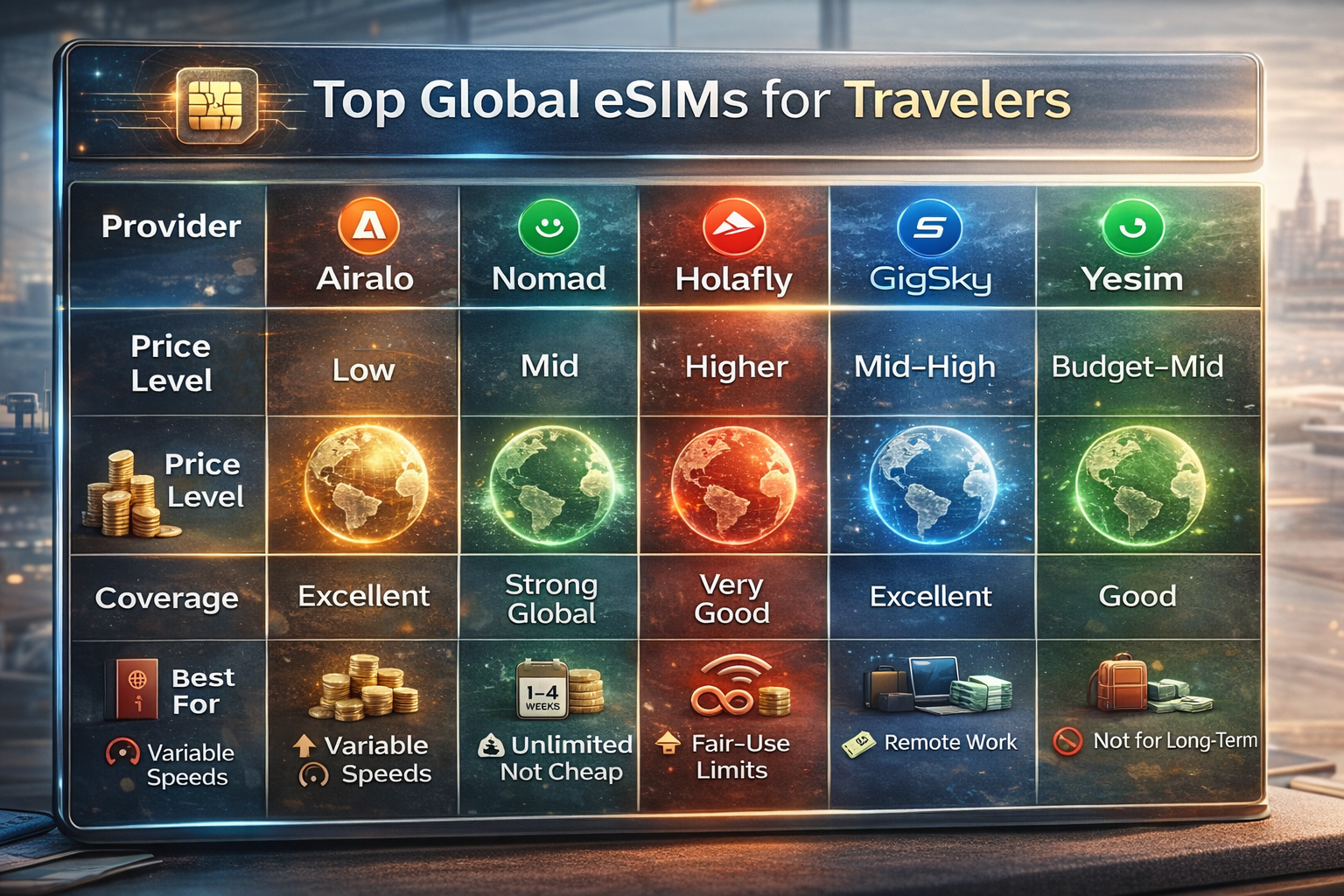
A travel eSIM lets you land connected without swapping physical SIM cards or relying on airport Wi-Fi.
Why eSIM Matters More Than Many Travelers Realize
A lot of people still treat connectivity like something they will “figure out later” after landing. That mindset worked better years ago when travel moved more slowly and fewer trip functions depended on mobile apps. Today, that delay can create unnecessary friction immediately. Airport transfer apps, digital boarding passes, translation tools, online check-in systems, train tickets, and bank verification messages all expect your phone to be working now, not eventually.
The real value of an eSIM is not just convenience. It is continuity. You can install a data plan before you leave, keep your regular SIM in place, and switch to travel data when needed without carrying a tiny plastic card or risking losing your home number setup. Official provider pages also highlight that device compatibility and unlocked status matter, which is why checking those before purchase is part of the process. :contentReference[oaicite:1]{index=1}
For travelers who cross more than one country on a single trip, eSIMs also remove a classic pain point: needing a new SIM every time you move. A regional or global plan can keep you connected across borders without repeating the whole setup process, which is especially valuable on multi-city or multi-country itineraries. Airalo, Nomad, Holafly, and GigSky all position themselves around this cross-border convenience, though the details differ by plan. :contentReference[oaicite:2]{index=2}
Why This Choice Matters
The wrong eSIM usually does not fail dramatically. It fails in annoying ways: you buy too little data, your speeds feel inconsistent, your hotspot expectations are wrong, or your plan is fine on paper but mismatched to how you actually travel.
What Is an eSIM?
An eSIM, or embedded SIM, is a digital SIM profile built into compatible smartphones and devices. Instead of inserting a physical SIM card, you download a plan digitally—usually through an app or QR code—and activate it on your device. That means no plastic SIM handling, no tray tool, and no need to physically replace your regular SIM every time you travel.
How eSIMs differ from physical SIM cards
- No physical card to insert, lose, or swap during the trip
- Activation can often happen before departure
- You can usually keep your home SIM active while using the travel eSIM for data
- Managing plans is often easier through an app than through a local shop visit
Why travelers like them
- Fast setup and less airport hassle
- Flexible single-country, regional, or global plans
- Usually lower friction than roaming
- Useful for backup data, work trips, and border-hopping itineraries
Limitations you should keep in mind
- Your phone must support eSIM and be unlocked
- Many travel plans are data-only, so calls and SMS often rely on apps
- Hotspot allowance is not the same across providers or destinations
- Some plans sound unlimited but still apply fair-use or speed management policies
Fast Decision Rules
- If you travel 3 to 7 days: capped budget plans often make more sense than expensive unlimited-style plans
- If you travel 2 to 4 weeks: stability and refill flexibility matter more than the very lowest price
- If you hotspot, work online, or stream often: a higher-cap or unlimited-style option is safer
- If you visit multiple countries: regional coverage often beats repeatedly buying single-country plans
Mistakes Travelers Make With eSIMs
- Buying too little data: maps, photo uploads, and ride apps burn through small plans faster than expected
- Waiting until arrival to install: setup is much easier when you still have stable Wi-Fi before flying
- Assuming unlimited means no limits at all: many plans still manage speeds after heavy use
- Ignoring device lock status: a carrier-locked phone can block third-party eSIM use
Top 5 Global eSIM Providers Compared
1) Airalo
Best for: Budget travelers, short trips, and broad destination access
Airalo is one of the most recognized names in travel eSIMs. Officially, it highlights availability across 200+ destinations and promotes local, regional, and global choices through one marketplace. That breadth is a big part of why it stays popular. :contentReference[oaicite:3]{index=3}
- Strong destination coverage and easy browsing
- Usually attractive for short-term, lighter-use travelers
- App-based setup is straightforward for most users
Downside: Small capped plans can feel tight if your trip becomes more map-heavy, social, or hotspot-dependent than expected.
2) Nomad
Best for: Travelers who want balance, predictability, and less guesswork
Nomad positions itself around international travel in 200+ destinations and offers both regional and global options. In practice, it often feels like a safe middle-ground choice: not always the cheapest, but often easier to understand than overly fragmented plan menus. :contentReference[oaicite:4]{index=4}
- Clearer plan structure than some marketplaces
- Good fit for medium-length travel
- Often appealing for users who want fewer surprises
Downside: The absolute lowest-cost traveler can sometimes find a cheaper capped alternative elsewhere.
3) Holafly
Best for: Heavy data users, remote work, and travelers who hate monitoring usage
Holafly strongly markets unlimited-style and global-crossing convenience. Its current plans messaging emphasizes one eSIM across multiple destinations, unlimited browsing, and easier cross-border use, but hotspot availability can vary by plan and destination, so checking the product page matters. :contentReference[oaicite:5]{index=5}
- Lower anxiety for travelers who use lots of data
- Simple value proposition for non-technical users
- Good psychological fit for work trips and heavy app use
Downside: Price is usually higher, and “unlimited” still deserves a fair-use reality check before purchase.
4) GigSky
Best for: Reliability-first travelers and work-focused trips
GigSky emphasizes international/global connectivity, cross-border convenience, and device-unlock readiness. It also leans into travel use cases such as cruises and broader world coverage, making it appealing to travelers who care less about bargain pricing and more about service consistency. :contentReference[oaicite:6]{index=6}
- Strong reliability-oriented positioning
- Comfortable option for business or longer itineraries
- Useful if you value stable connectivity over chasing the cheapest plan
Downside: It often costs more than budget-friendly consumer-first providers.
5) Yesim
Best for: Budget-minded travelers and flexible top-up behavior
Yesim is a modern-feeling option that often appeals to travelers who want flexibility and a simpler refill mindset. It is often discussed alongside Airalo for price-sensitive travelers, especially when the trip is shorter and the need is mostly data rather than a more business-critical setup.
- Good fit for travelers watching budget closely
- Flexible for shorter itineraries and top-up behavior
- Often easier to justify for casual holiday use than pricier premium picks
Downside: Depending on route and destination mix, plan variety may not feel as broad as the biggest marketplace-style options.
A vs B: Which One Should You Actually Pick?
| Comparison | What It Means in Real Travel |
|---|---|
| Airalo vs Nomad | Airalo is often better for price-focused short trips; Nomad often feels more stable and easier to evaluate calmly. |
| Holafly vs GigSky | Holafly is stronger if heavy data is your main fear; GigSky is better if reliability-first travel matters more than bargain pricing. |
| Yesim vs Airalo | Both appeal to budget-conscious travelers, but Yesim can feel more top-up-friendly while Airalo often wins on familiarity and scale. |
| Regional vs Global Plan | If your route stays within one region, a regional plan is often the smarter balance of price and convenience than a broader global plan. |
Which eSIM Should You Choose?
- Short trips (3 to 7 days): Airalo or Nomad
- Longer stays (2 to 4 weeks or more): Nomad, GigSky, or Holafly depending on data appetite
- Remote work or heavy hotspot usage: Holafly first, GigSky second
- Multi-country travel: Airalo or Nomad regional/global options
- Budget-focused travel: Airalo or Yesim
- Business travel with lower tolerance for connectivity stress: GigSky
Thailand Example: Why the Right eSIM Changes the Trip
Thailand is a good example of why eSIM choice matters in practice. It is the kind of destination where your phone quickly becomes central to movement: calling rides, checking routes, translating addresses, and coordinating bookings. If you are using apps heavily throughout the day, a tiny starter plan can feel too restrictive faster than expected.
On shorter trips, capped plans from providers like Airalo or Nomad can still work perfectly well if your usage is moderate and you are not tethering devices. But if you know you rely heavily on ride-hailing, maps, repeated uploads, hotspot, or remote work, the psychological ease of a bigger or unlimited-style option becomes worth paying for. That is the kind of judgment that matters more than any generic “best eSIM” claim.
FAQ
Is a global eSIM the same as a regional eSIM?
No. Global eSIMs cover many countries across multiple regions, while regional eSIMs focus on one region such as Europe or Asia. If your trip stays inside one region, the regional option is often better value.
Do I need to turn off my physical SIM?
Not always. Many travelers keep their home SIM active for SMS or OTP use and switch mobile data to the travel eSIM.
Which eSIM is best for Thailand travel?
If you rely heavily on maps, ride apps, and constant data access, Holafly can feel more comfortable. For shorter and lighter trips, Airalo or Nomad often works well.
Is Holafly truly unlimited?
Holafly markets unlimited-style plans in many destinations, but fair-use or technical conditions can still apply. Always check the exact plan page before buying. :contentReference[oaicite:7]{index=7}
Can I install an eSIM before I travel?
Yes, and that is usually the best move. Installing before departure reduces stress and avoids depending on airport Wi-Fi after landing.
What if my phone is carrier-locked?
A locked phone may block third-party eSIMs. GigSky and Airalo both explicitly point travelers toward unlocked device requirements, so verify that first. :contentReference[oaicite:8]{index=8}
How much data do I need for a 7-day trip?
For maps, messaging, browsing, and light daily use, 3 to 5GB can be enough. If you hotspot, upload heavily, or stream, aim much higher.
Related Reads on Trip Nexus
Official and Authoritative Sources
Final Thoughts
A good eSIM removes friction from travel. Instead of wasting energy on airport SIM shops or worrying about surprise roaming fees, you arrive connected and ready to move. That alone can make the first few hours of a trip feel dramatically smoother.
The real trick is not asking which provider is “best” in the abstract. Ask which one fits how you travel. If you are budget-focused, Airalo or Yesim often makes sense. If you want balance and predictability, Nomad is a strong pick. If you use lots of data and hate thinking about limits, Holafly is usually the safer comfort choice. If you care most about reliability-first travel, GigSky deserves a close look.
Choose based on itinerary, region count, and data behavior. With the right plan, your phone becomes a travel tool—not a travel headache.