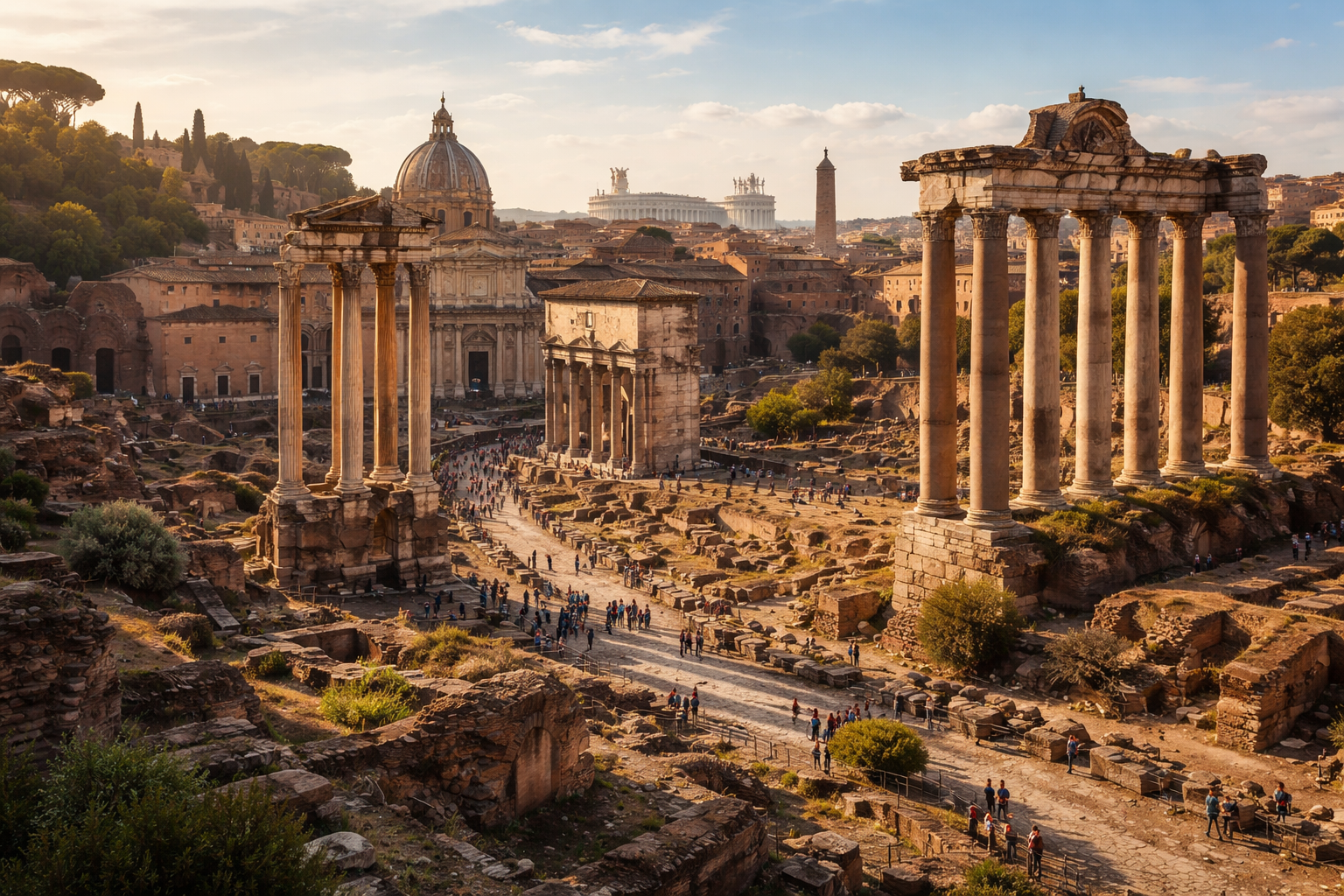
Exploring the Roman Forum in Rome is one of the most immersive ways to understand how ancient Roman civilization actually functioned. More than a collection of ruins, the Roman Forum was the political, religious, and commercial heart of the empire for centuries. Walking through this open-air archaeological site places you directly on the same stone paths once used by emperors, senators, and citizens.
This guide focuses on how to navigate the Roman Forum efficiently, highlights the most important structures, and explains how to combine your visit with Palatine Hill and the Colosseum for a complete ancient Rome experience.
Key Information
| Official tickets | ticketing.colosseo.it (Parco Archeologico del Colosseo) |
| Opening hours | Daily 8:30 AM – 7:00 PM (last entry 6:15 PM) |
| Entrance fee | Combined ticket with Colosseum & Palatine Hill: €18 (reduced €9) |
| Address | Via della Salara Vecchia, 5/6, 00186 Roma RM, Italy |
| Best time to visit | Early morning (8:30–10:30 AM) or late afternoon (4:00–6:00 PM) |
| Getting there | Metro B to Colosseo station (5-minute walk), buses 75 / 81 / 850 |
Historical Background
The Roman Forum served as the center of public life in ancient Rome from the 7th century BC through the Imperial period. Originally a marshland drained by the Cloaca Maxima, it evolved into a monumental civic space lined with basilicas, temples, and administrative buildings.
Here, senators debated in the Curia Julia, merchants traded goods, and triumphal processions marched along the Via Sacra. As imperial power declined, the Forum fell into ruin and was later quarried for building materials. Rediscovered during the Renaissance, it became a powerful symbol of Rome’s historical legacy and remains one of the city’s most important archaeological sites.
Main Attractions Inside the Roman Forum
Temple of Saturn
Dating back to around 497 BC, the Temple of Saturn is among the oldest structures in the Forum. Though only eight Ionic columns remain, the temple once housed Rome’s state treasury (aerarium), safeguarding gold reserves and official documents.
Located near the Arch of Septimius Severus, this site is best viewed in the morning light. Allow 10–15 minutes to study the surviving columns and imagine the imposing structure that once dominated the western Forum.
Arch of Titus
Erected in 81 AD, the Arch of Titus commemorates Emperor Titus’s victory in the Judean War. Reliefs inside the arch famously depict Roman soldiers carrying spoils from Jerusalem, including the Menorah.
This monument marks the eastern end of the Forum and stands directly along the Via Sacra. Its artistic influence later inspired triumphal arches across Europe, including the Arc de Triomphe in Paris.
Curia Julia (Roman Senate House)
The Curia Julia is the best-preserved building in the Roman Forum. Restored during the reign of Diocletian, it served as the Senate house where laws shaping the Roman Republic and Empire were debated.
Inside, original walls and floors remain visible. The modest scale of the building contrasts with the vast open Forum, offering insight into the political workings of ancient Rome.
Basilica of Maxentius and Constantine
The Basilica Nova is the largest structure in the Forum. Begun by Emperor Maxentius and completed by Constantine in the early 4th century, its massive concrete vaults demonstrate the height of Roman engineering.
Once used for legal and administrative purposes, the basilica originally housed a colossal statue of Constantine. Today, its towering arches remain one of the most striking visual elements of the Forum.
Recommended Walking Route
This clockwise route covers the highlights efficiently in approximately 2–2.5 hours:
- Start at the Arch of Titus and examine the reliefs (10 minutes).
- Walk west along the Via Sacra to the Temple of Saturn (10–15 minutes).
- Proceed south to the Basilica of Maxentius (15 minutes).
- Head northwest to the Curia Julia (10 minutes).
- Finish near the Temple of Vesta and House of the Vestal Virgins.
- Optional: continue up to Palatine Hill for panoramic views.
Practical Tips for Visiting
- Wear sturdy walking shoes; surfaces are uneven.
- Book tickets online in advance during peak season.
- Carry water, especially in summer.
- Allow at least half a day if combining with Palatine Hill and the Colosseum.
FAQ
How long does it take to visit the Roman Forum?
Most visitors spend 1.5–2.5 hours in the Forum itself. Combined with Palatine Hill, plan for 3–4 hours.
Is the Roman Forum included with Colosseum tickets?
Yes. Standard Colosseum tickets typically include entry to the Roman Forum and Palatine Hill.
What is the best time of day to visit?
Early morning offers cooler temperatures and fewer crowds. Late afternoon provides softer light for photography.
Final Thoughts
The Roman Forum is essential for understanding the scale and complexity of ancient Rome. From political debates in the Curia to triumphal marches beneath the Arch of Titus, every section reveals a different layer of history. Pairing your visit with Palatine Hill and the Colosseum completes the picture of Rome’s imperial core and creates one of the most rewarding archaeological experiences in Europe.