Camellia Hill Jeju Travel Guide (2026): Winter Blooms, Hydrangea Summers & Photo Spots
A complete Camellia Hill Jeju travel guide is essential for anyone visiting Korea’s largest island, because this is not merely a botanical garden—it is the crown jewel of Jeju’s winter tourism. Spanning 172,000 square meters in the quiet southern countryside of Andeok-myeon, Camellia Hill holds the title of the largest camellia arboretum in East Asia. With over 6,000 trees ranging from vivid crimson to delicate pink, this garden transforms the stark volcanic landscape into a romantic, living canvas, offering a serene escape that changes dramatically with every season.
You are planning a trip to Jeju Island and have seen the stunning Instagram photos of red flower tunnels and volcanic stone walls. You need practical, 2026-verified details: when exactly do the camellias peak (to avoid seeing brown, fallen petals), how to reach this remote location using public buses from Jeju City or Seogwipo, whether it is worth visiting in summer for the hydrangeas, and how to navigate the massive grounds to find the best “secret” photo zones without waiting in long lines.
Quick Summary (Save This)
- Peak Season Accuracy: The famous red camellias peak from December to February. However, the garden is equally famous for massive blue hydrangeas in June and July.
- The “Instagram” Factor: This is a photography-heavy destination. Expect queues at popular spots like the string light tunnels and benches with “I Love You” garlands.
- Transport Reality: It is located in the countryside (Andeok). If not driving, take the 282 bus to “Donggwang Transfer Center” and transfer to a taxi (approx. 5,000 KRW) to save time.
- Shoes Matter: The paths are made of volcanic scoria (red stone) and soil. They get muddy in winter and after rain. Do not wear white canvas shoes.
- Time Budget: The grounds are deceptive; they look small on the map but are vast. Allocate at least 2 hours to walk the full loop at a relaxed pace.
The Atmosphere: A Winter Wonderland of Red and Green
Jeju Island in winter can be windy and harsh, but stepping into Camellia Hill feels like entering a sheltered, secret garden where spring never left. The dense walls of evergreen trees block the biting coastal winds, creating a calm, quiet microclimate. As you walk through the entrance, the first thing you notice is the color contrast: the glossy, deep green leaves, the rough, black volcanic basalt walls, and the shocking bursts of red and pink blossoms.
It is a place of textures and silence. The ground beneath your feet creates a satisfying crunch—it is covered in songi (red volcanic scoria), a natural filter unique to Jeju. In the distance, you can hear the faint hum of visitors’ conversations and the rustle of the wind in the camphor trees. Whether you visit under the bright winter sun or during a misty island drizzle, the garden possesses a melancholic, romantic beauty that feels distinctively Korean.
What It Feels Like (The Slow Life)
Camellia Hill is designed around the concept of “Slow Life.” You will see this phrase painted on wooden signs throughout the park, and the layout forces you to adhere to it. The paths wind gently, curving around old trees and stone mounds, preventing you from rushing from point A to point B. It feels intimate, almost like wandering through a private estate rather than a public park.
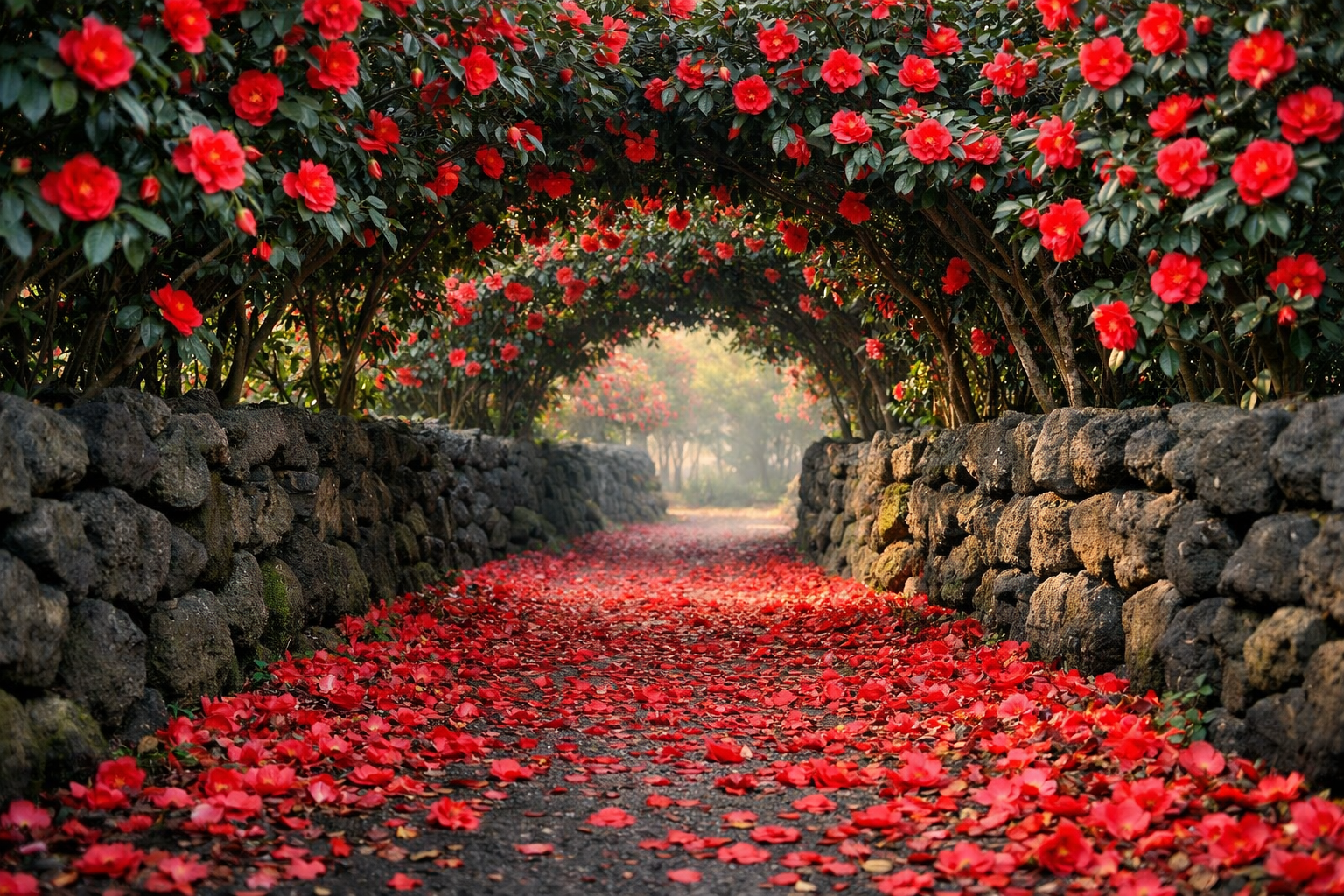
In the “Secret Garden” section, the canopy is low, creating a tunnel of flowers. When the wind blows, petals fall like red snow, carpeting the ground. It creates a surreal, dreamlike sensation. Even when the park is crowded, the sheer number of winding sub-paths allows you to find a solitary bench, sit under a 300-year-old camellia tree, and simply breathe in the clean, crisp Jeju air.
The iconic ‘Red Carpet’ of fallen camellia petals. This phenomenon usually occurs in late winter (February), creating one of Jeju’s most famous photographic moments.
The Symbolism of the Camellia (Dongbaek)
In Korean culture, the camellia (known as Dongbaek) holds a deep, poignant significance. Blooming in the harshness of winter when all other life is dormant, it symbolizes faithfulness, endurance, and longevity. Unlike other flowers that wither on the stem, the camellia flower drops its entire head while still in full bloom, representing a noble and sudden death.
For the people of Jeju, the camellia is also historically linked to the tragic Jeju April 3rd Incident (4.3 Uprising), serving as a symbol of the innocent souls lost. While Camellia Hill is a place of joy and tourism, the flower itself carries this weight of island history. The garden was painstakingly cultivated over 30 years by one man’s passion to create a sanctuary that honors this resilient beauty.
The red gravel paths you walk on are not just decorative. They are Songi, a rare volcanic scoria found only on Jeju. It emits far-infrared rays and is excellent for drainage, keeping the soil healthy for the camellias. You are literally walking on the volcanic DNA of the island.
Essential 2026 Visitor Information
| Address | 166 Byeongak-ro, Andeok-myeon, Seogwipo-si, Jeju-do |
|---|---|
| Winter Hours (Nov-Feb) | 08:30 – 18:00 (Last admission at 17:00). |
| Summer Hours (Jun-Aug) | 08:30 – 19:00 (Last admission at 18:00). |
| Admission Fee (2026) | Adults: 10,000 KRW / Youth: 8,000 KRW / Children: 7,000 KRW. |
| Parking | Free and spacious, located directly across from the entrance. |
| Best For | Couples, photographers, flower lovers, and families with toddlers. |
| Pet Policy | Small dogs (<8kg) allowed on a leash. Large dogs usually restricted. |
Top 3 Seasonal Experiences
Camellia Hill is not a static museum. It completely reinvents itself depending on the month you visit. Choose your season wisely.
From November to February, this is the main event. Over 500 varieties of camellias from 80 countries bloom in waves. The highlight is the “Baby Camellia” garden, where shorter trees create a dense maze of pink flowers, perfect for portrait photography. The stone walls draped in red petals create the classic Jeju winter aesthetic.
Many travelers don’t realize that Camellia Hill is also a top summer destination. In June and July, the Glass House and the outdoor trails are filled with massive, pom-pom-like hydrangeas in shades of electric blue, purple, and pastel pink. It is arguably even more colorful than the winter season.
Come September and October, the “Mirror Pond” area transforms into a dreamy landscape of soft Pink Muhly grass and towering Pampas grass (Silver grass). The autumn light hitting these feathery plants creates a golden-hour glow that is incredibly popular for wedding shoots and romantic strolls.
Crucial Tips & Warnings
The volcanic soil paths become extremely muddy and slippery after rain or snow. Avoid wearing white sneakers or high heels. Sturdy boots or dark-colored walking shoes are strongly recommended.
Camellia Hill is in a rural area. While getting there by taxi is easy, calling a taxi to leave can be difficult, especially in the late afternoon. Use the Kakao T app to call a taxi 15 minutes before you plan to leave.
Halfway through the course, there is a large greenhouse cafe. It is the perfect pitstop to warm up with a hot tangerine tea or camellia tea. It also has a nice lawn for children to run around.
A vs B: Which Jeju Garden?
Jeju has many botanical gardens. The biggest rival to Camellia Hill is Hueree Natural Park. Which one should you choose?
| Feature | Option A: Camellia Hill | Option B: Hueree Natural Park |
|---|---|---|
| Primary Focus | Botanical, quiet, romantic, photo-zones with text garlands. | Activity-based, lively, famous for the “Black Pork Show” (pigs sliding). |
| Camellia Scale | Massive. East Asia’s largest arboretum dedicated to camellias. | Large, but part of a mix with other attractions like animal feeding. |
| Vibe | Couples, slow walking, Instagram aesthetics. | Active families, children who want to interact with animals. |
| The Verdict | Choose this if you want beautiful photos and a peaceful walk. | Choose this if you have energetic kids who need entertainment. |
Step-by-Step: The Perfect Morning Loop
The garden is a one-way loop. Following this route ensures you see the highlights without getting lost in the maze.
Step 1: The Wildflower Trail (Entrance)
Start at the main gate. The first 15 minutes are a gentle walk through the “Wildflower Trail” and “European Camellia Forest.” Stop at the famous photo spot with the banner reading “Love you more than yesterday.”
Step 2: The Glass House & Greenhouse
About 30 minutes in, you’ll reach the main conservatory. In winter, rare camellias bloom here. In summer, it’s a hydrangea haven. Grab a coffee at the cafe next door.
Step 3: The Mirror Pond & Observation Deck
Continue to the large pond area. In autumn, this is Pink Muhly central. Walk up to the small observatory tower for a view of Sanbangsan Mountain and the southern sea in the distance.
Step 4: The Grass Plaza & Exit
The final stretch is a wide open lawn (perfect for kids to run) leading to the souvenir shop. Pick up some camellia oil or camellia-scented soap before you leave.
Insider Hacks: Beating the Crowds
- The “Reverse” Trick: Most people stop at the very first photo zone near the entrance, creating a bottleneck. Skip the first 2-3 spots! The photo zones deeper inside the park (near the Secret Garden) are identical but often completely empty.
- Golden Hour: In winter, the sun sets early (around 5:30 PM). Arrive at 3:30 PM to catch the “Golden Hour” light filtering through the trees. The camellia petals glow intensely in this light.
- Bus Navigation: If taking the bus, look for the 282 bus (Jeju Intercity Bus Terminal to Seogwipo). Get off at “Donggwang Transfer Center” and take a quick taxi. It saves 40 minutes compared to trying to find a direct local bus connection.
Pre-Visit Action Checklist
Jeju weather is unpredictable. Check these items before you drive to Andeok.
Frequently Asked Questions (FAQ)
1. Is Camellia Hill worth visiting in summer?
Yes! While famous for winter camellias, the summer hydrangea festival (June-July) is spectacular. The entire garden turns blue and purple.
2. How much is the entrance fee?
As of 2026, it is typically 10,000 KRW for adults, 8,000 KRW for youths, and 7,000 KRW for children. Prices may fluctuate slightly by season.
3. Is it wheelchair accessible?
Partially. The main paths are flat and wide enough for wheelchairs, but some side trails and the observatory area have steps or uneven stone paths. Strollers can navigate most of the main loop.
4. How long does the tour take?
Plan for 1.5 to 2 hours. If you take many photos or stop for tea, allow 2.5 hours.
5. Can I bring my dog?
Small dogs (under 8kg) are generally allowed if they are on a leash. However, large dogs are usually restricted. Always check the latest policy at the ticket booth.
6. Is there food inside?
There is a cafe serving drinks and light snacks (cake, cookies) inside, but no full meals. Plan to eat lunch at a nearby restaurant in Andeok (e.g., Osulloc area) before or after.
7. What is nearby Camellia Hill?
The O’sulloc Tea Museum, Innisfree Jeju House, and the Hello Kitty Island museum are all within a 10-15 minute drive.
8. When do the camellias fall?
Camellias begin to drop in late February and March. This creates the beautiful “red carpet” effect on the ground, which is just as famous as the bloom on the trees.
Official Resources & Internal Travel Guides
Trip Nexus Asia Guides
Official & Authoritative Sources
Editorial Note (E-E-A-T): This guide to Camellia Hill Jeju was verified for the 2026 travel season. Seasonal bloom times (Camellia in Winter, Hydrangea in Summer), bus logistics via the 282 route, and admission fees have been cross-referenced with the Jeju Tourism Organization and local operational data to ensure accuracy for travelers.
Your Next Step
Before you head to Jeju, download the KakaoMap and KakaoTaxi apps. Google Maps will not give you accurate walking or driving directions on the island. Set up your account now to ensure a smooth journey to Andeok.