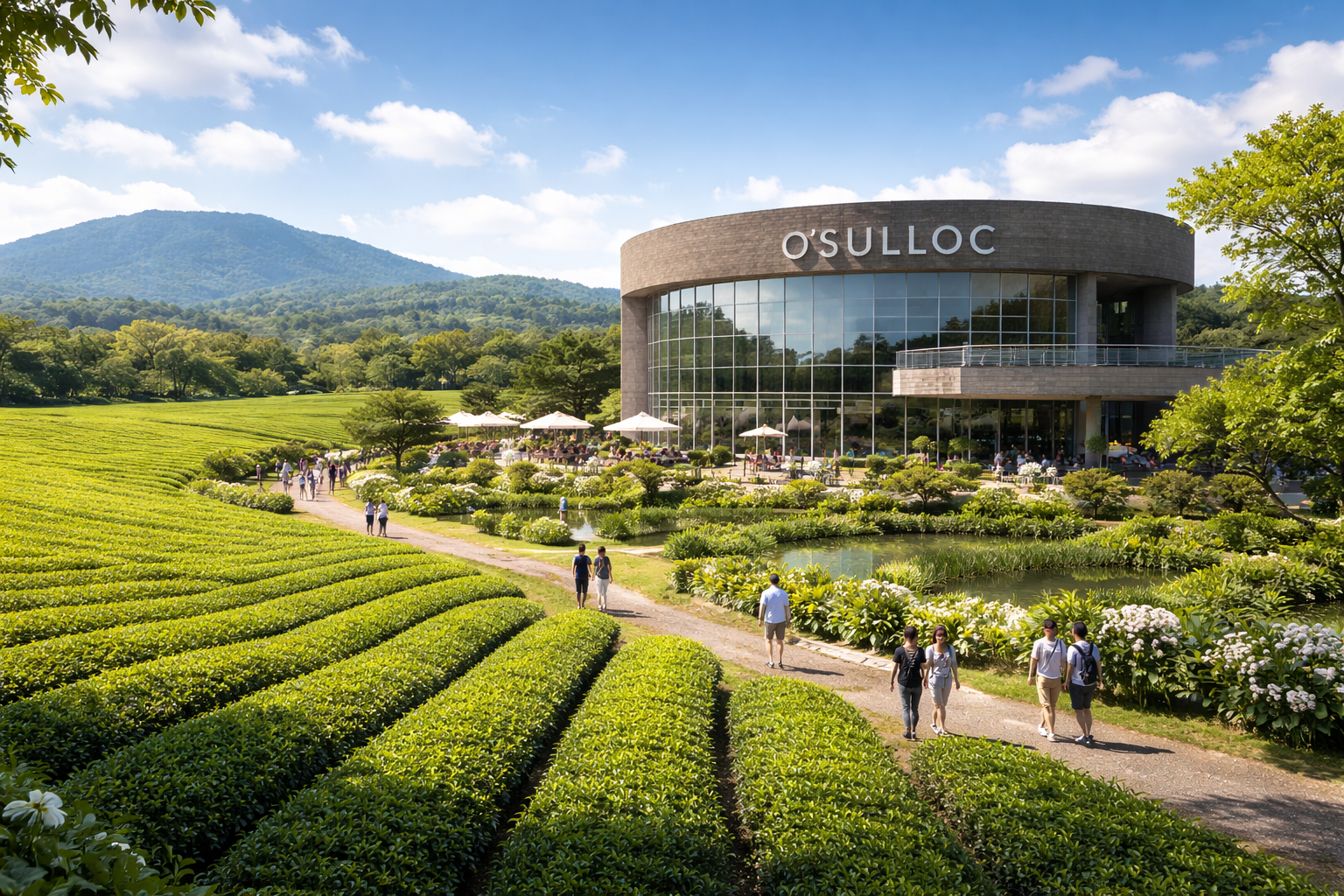
O’sulloc Tea Museum Guide: What It Feels Like, What to Expect & How to Visit It Right
O’sulloc Tea Museum in Jeju is one of the most atmospheric places on the island, where Korea’s tea culture, Jeju’s volcanic landscape, modern architecture, and café-style leisure all come together in one stop. This guide covers what to see, how long to stay, what the museum feels like in different seasons, what to eat, how to plan your route, and whether it is truly worth adding to a Western Jeju itinerary in 2026.
Search Intent
If you are looking up O’sulloc Tea Museum in Jeju, you are probably trying to answer a few practical questions at once: Is it just a photo stop, or is it actually worth your time? How long do you need? Is it better for tea lovers, families, couples, or first-time Jeju visitors? And should you combine it with nearby attractions in West Jeju? This article is designed to answer those questions in a clear, itinerary-friendly way.

Quick Summary
- 📍 Located in Andeok-myeon, Seogwipo, in Western Jeju near major day-trip routes.
- 🕒 Best visit time: weekday morning or late afternoon for fewer crowds and softer light.
- 💰 General admission is free, while selected premium experiences can cost extra.
- 🍵 Most visitors come for the tea fields, museum displays, gift shop, and signature desserts.
- ⏳ A realistic stay is 1.5 to 2.5 hours, longer if you add café time and nearby stops.
Why Visit O’sulloc Tea Museum in Jeju?
There are plenty of attractions in Jeju that are beautiful for ten minutes and forgettable after that. O’sulloc is not one of them. What makes this place work so well is that it is layered. At first glance, people come for the tea fields and the famous green color palette. Then they realize there is also a museum space, a polished retail and tasting environment, a dessert-focused café stop, and a very Jeju-specific landscape setting that feels calmer than many of the island’s more crowded tourist zones.
It is also one of the easier attractions to recommend to mixed groups. If one person loves food, another loves design, another wants scenic photos, and another simply wants somewhere comfortable and easy to enjoy, O’sulloc usually satisfies all of them at once. That is rare. Many Jeju attractions feel highly specialized. This one feels broadly usable.
From a travel-planning perspective, O’sulloc also works because it fits naturally into a West Jeju route. You do not need to build an entire day around it, but it can absolutely anchor a relaxed half-day or full-day schedule when paired with waterfalls, coastal viewpoints, museums, or tea-related stops nearby.

What It Feels Like to Visit
The first thing you notice is the color. Endless green rows stretch across Jeju’s dark volcanic ground, and that contrast is much stronger in person than in photos. The museum complex itself feels modern and composed, with large windows, clean lines, and an intentional sense of visual calm. It does not feel like an old-fashioned museum where you silently read wall text. It feels more like a lifestyle space built around tea culture.
What I personally like most is the shift in mood between outside and inside. Outside, the tea fields feel open, bright, and slightly cinematic, especially when clouds move quickly across the sky. Inside, the tone becomes quieter. The displays, ceramics, tea tools, and scent of brewed tea create a slower rhythm. Even visitors who are not deeply interested in tea usually respond to the atmosphere because it feels curated without becoming sterile.
There is also a subtle emotional quality here that is easy to miss if you rush. O’sulloc does not hit you with drama the way a cliffside view or a waterfall does. Instead, it builds a feeling gradually. You walk through the grounds, step inside, notice details, pause at the café, look back out at the fields again, and suddenly you realize you have slowed down. That is one reason so many Jeju itineraries keep returning to it.
To be honest, I would not describe it as a “must-see” in the same way I would describe a first sunrise at Seongsan Ilchulbong or a dramatic coastal drive. But I would absolutely call it one of the most satisfying and easiest places to recommend because it rarely disappoints when expectations are realistic.
Key Visitor Information
| Location | 15 Sinhwayeoksa-ro, Andeok-myeon, Seogwipo-si, Jeju-do |
|---|---|
| Operating Hours | Summer 09:00–19:00 / Winter 09:00–18:00 |
| Holiday | Open all year round |
| Admission | Free for general entry; some experience programs cost extra |
| Inquiries | +82-64-794-5312 |
| Parking | Available on-site |
| Accessibility | Generally comfortable for easy walking, café visits, and short museum browsing |
Why It Matters in Korean Tea Culture
O’sulloc is not simply a scenic tea farm with a café attached. It represents a modern, branded interpretation of Korean tea culture that many international visitors can actually access without prior background knowledge. Traditional tea culture can sometimes feel distant to first-time travelers because it is presented in overly formal settings or explained with too much historical context at once. O’sulloc bridges that gap.
The museum introduces tea not only as a drink, but as part of a broader Korean aesthetic: ceramics, ritual, regional identity, landscape, craftsmanship, and sensory appreciation. That matters because Jeju’s environment plays a real role in how the place is understood. The fields, climate, volcanic soil, and island imagery are part of the storytelling, not just the backdrop.
In practical terms, this makes O’sulloc one of the easier gateways into Korean tea culture for travelers who are more familiar with coffee culture or modern dessert cafés. You do not need specialist knowledge to enjoy it. The place is designed to welcome curiosity.
Hands-On Tea Experiences and What to Try
One of the reasons O’sulloc stays memorable is that it is not only visual. There is something to taste, smell, and participate in. The main museum and tea house experience is enough for many visitors, but if you want more depth, premium tea experiences give the visit additional structure. The official Tea Stone premium tea course includes a garden walk, a story-driven tea ceremony segment, tea cocktails with Jeju ingredients, and an organic tea roasting and packaging workshop.
That kind of experience is especially appealing if you want the stop to feel more intentional than simply “walk around, take photos, buy dessert.” Even without booking a course, though, the food and drink side of O’sulloc is a major part of the attraction. The most talked-about items are usually green tea soft-serve, matcha-themed desserts, and signature café options that tie the museum to Jeju’s broader café culture.
If I were choosing a strategy for a first visit, I would keep it simple: walk the grounds first, browse the museum second, then sit down for dessert or tea after you have already absorbed the place. That order works better than eating first because the café feels like a reward rather than the entire point of the stop.
Best Season to Visit O’sulloc Tea Museum
O’sulloc changes meaningfully with the season, and that is worth planning around. Spring is arguably the prettiest for visitors who care about fresh tea-field visuals, new growth, and bright color contrast. This is when the place feels most alive in the classic “green Jeju” sense. It is also one of the easiest times to get that polished postcard feeling from the landscape.
Summer gives the fields density and energy, but it can also feel hotter, more humid, and busier. If you go in summer, arriving earlier in the day helps a lot. Autumn is one of the strongest seasons overall because the skies are often clearer, the air feels better for walking, and the attraction still looks vibrant without summer’s heat. Winter is quieter and more restrained. It may not deliver the same lush visual punch, but it can feel more spacious and calm.
Personally, I think autumn is the easiest season to recommend for balanced comfort, while spring is the most photogenic if the weather cooperates.
Main Highlights Inside the Complex
- Tea field views: The visual identity of O’sulloc starts here. This is the most photo-friendly area and the most immediate reason many people stop.
- Museum display space: A polished introduction to Korean tea culture, tea utensils, and O’sulloc’s brand storytelling.
- Tea house and dessert zone: One of the most crowd-pleasing parts of the visit, especially for travelers who want a snack break rather than a purely educational stop.
- Gift and retail area: Useful if you want tea souvenirs that feel more premium and better packaged than generic tourist-shop items.
- Premium experience options: Best for visitors who want an interactive layer instead of a quick browse-and-leave stop.
How Long Should You Stay?
For most travelers, 1.5 to 2 hours is the sweet spot. That gives you enough time to walk the grounds, look through the museum area, browse the shop, and enjoy a drink or dessert without turning the visit into a drag. If you move slowly, take photos carefully, or wait in café lines during busy times, 2 to 2.5 hours is more realistic.
A very quick stop of under one hour is possible, but it usually feels rushed and reduces the attraction to a checklist item. On the other hand, spending half a day here only makes sense if you intentionally booked an experience, want a very relaxed café session, or are using the stop as a low-pressure break within a West Jeju itinerary.
My honest recommendation is to think of O’sulloc as a strong mid-length stop rather than the entire day’s main event. It shines when combined with one or two nearby attractions that offer a different texture.
How to Build It Into a West Jeju Route
O’sulloc is easiest to enjoy when it is placed in the middle of a day rather than forced into an awkward final stop. A common rhythm is to pair it with one scenic natural attraction and one slower café or museum-style attraction. For example, you can begin with a coastal or waterfall stop, move to O’sulloc for a calmer late morning or lunch-adjacent break, and then continue to another western or southwestern Jeju destination.
Because the museum offers shade, seating, drinks, shopping, restrooms, and easy walking, it works particularly well as a “reset point” in your itinerary. If you have been driving or moving through several outdoor attractions, O’sulloc gives the day a more comfortable center.
This is also why it works well with mixed-age groups. It is not physically demanding, yet it still feels meaningful. That combination can be hard to find in Jeju itineraries.
O’sulloc vs Other Jeju Attractions
| Attraction | Best For | Main Trade-Off |
|---|---|---|
| O’sulloc Tea Museum | Culture + scenery + café + shopping | Less dramatic than Jeju’s top natural icons |
| Cheonjeyeon Waterfall | Nature, walking, mythic atmosphere | More route-focused and less relaxing as a café stop |
| Jeju Folk Village | Traditional architecture and cultural immersion | Less food-driven and less visually minimalist |
| Coastal viewpoints / cliffs | Big scenery and open-air visuals | Often shorter, more weather-dependent stops |
Who Should Visit O’sulloc Tea Museum?
This attraction is especially strong for first-time Jeju travelers, couples, casual culture-seekers, café-focused travelers, and families who want something visually attractive without a physically demanding route. It is also a very good fit for people who like “soft sightseeing” — attractions that are meaningful, photogenic, and comfortable rather than intense.
If you are only interested in big natural spectacle, you may rank other Jeju sites higher. If you are deeply into tea, design, Korean lifestyle culture, or aesthetic museum spaces, O’sulloc will likely outperform your expectations. It is also one of the few places I would confidently recommend even to someone with only a moderate interest in the subject, because the overall experience is broader than tea alone.
Insider Tips
- Arrive before the late-morning rush if you want cleaner photos and shorter café lines.
- Do the outdoor field walk first in case weather changes later in the visit.
- Do not treat it as only a dessert stop; the museum layer is part of why the attraction feels complete.
- Pair it with nearby West Jeju stops rather than forcing a long cross-island detour just for one museum.
- Bring sunglasses on bright days because the fields and pale surfaces can reflect more light than expected.
- If you like buying edible souvenirs, this is one of the safer places to pick up tea-related gifts that feel polished and travel-friendly.
Related Trip-Nexus Guides
FAQ – O’sulloc Tea Museum in Jeju
Is O’sulloc Tea Museum free?
Yes. General admission is free, but certain premium tea experiences or workshops may require a separate fee.
How long should I stay at O’sulloc Tea Museum?
Most travelers spend around 1.5 to 2.5 hours depending on crowds, café time, shopping, and whether they book an experience.
Is O’sulloc Tea Museum worth visiting if I am not a tea lover?
Yes. The attraction also works for architecture, scenery, dessert, light shopping, and relaxed sightseeing, so you do not need to be a tea specialist to enjoy it.
What is the best time of day to visit?
Weekday mornings are usually the easiest for lighter crowds, while later afternoon can offer softer light for the fields.
Can I visit O’sulloc as part of a West Jeju day trip?
Absolutely. It is one of the easiest attractions to combine with nearby West or Southwest Jeju stops because it offers both scenic value and a comfortable rest point.
What should I eat at O’sulloc?
Most first-time visitors go for green tea soft-serve, matcha desserts, or tea drinks, though seasonal menu items can also be worth checking.
Is O’sulloc good for families?
Yes. It is relatively easy to walk, visually engaging, and not physically demanding, which makes it a practical stop for mixed-age groups.
Which season is best for O’sulloc Tea Museum?
Spring is often the most photogenic for fresh tea-field color, while autumn is one of the most comfortable overall for weather and walking.
Official & Tourism Resources
Location Map
Planning a Jeju Itinerary?
Combine O’sulloc Tea Museum with a Western Jeju route that includes one scenic nature stop and one relaxed café or culture stop. It is one of the easiest places on the island to turn into a genuinely satisfying half-day plan.