Baengma River Buyeo Travel Guide 2026: Best Walks, Routes, and Baekje Heritage Tips
Baengma River (Baekma River) isn’t just a scenic ribbon of water—it’s Buyeo’s quiet corridor through Baekje-era heartland.
Think soft meadows, wide skies, and historic silhouettes that make you slow down without trying.
Search Intent
You’re here to figure out what Baengma River is, where to walk, how to pair it with Buyeo’s Baekje sites,
and what to do nearby—with practical tips and a map you can use immediately.
Quick Summary (5 lines)
- Best vibe: early morning or late afternoon for soft light and calmer paths.
- Best plan: riverside walk → Baekje museum/context → one “wow” viewpoint or fortress stop.
- Time needed: 1–2 hours for the river; 4–6 hours if you bundle heritage sites.
- Don’t miss: pairing the river with Buyeo’s Baekje story (it changes the whole mood).
- Good for: families, seniors, photographers, slow-travelers, and quiet-day seekers.
Why Visit Baengma River in Buyeo
Baengma River is where Buyeo feels most “honest.” No ticket gate. No forced route. Just a broad, calm river landscape that naturally connects
you to the story of the Baekje capital area. In many guides you’ll see “Baekma River” used for the historic river segment running through Buyeo,
often highlighted for cycling and heritage-adjacent viewpoints.
- Slow-travel friendly: flat-ish stretches for walking, cycling, and relaxed picnics.
- Heritage nearby: Buyeo is packed with Baekje context—easy to combine in one day.
- Seasonal beauty: spring greens, autumn gold, winter stillness (and fewer people).
What It Feels Like (First-Time Walk)
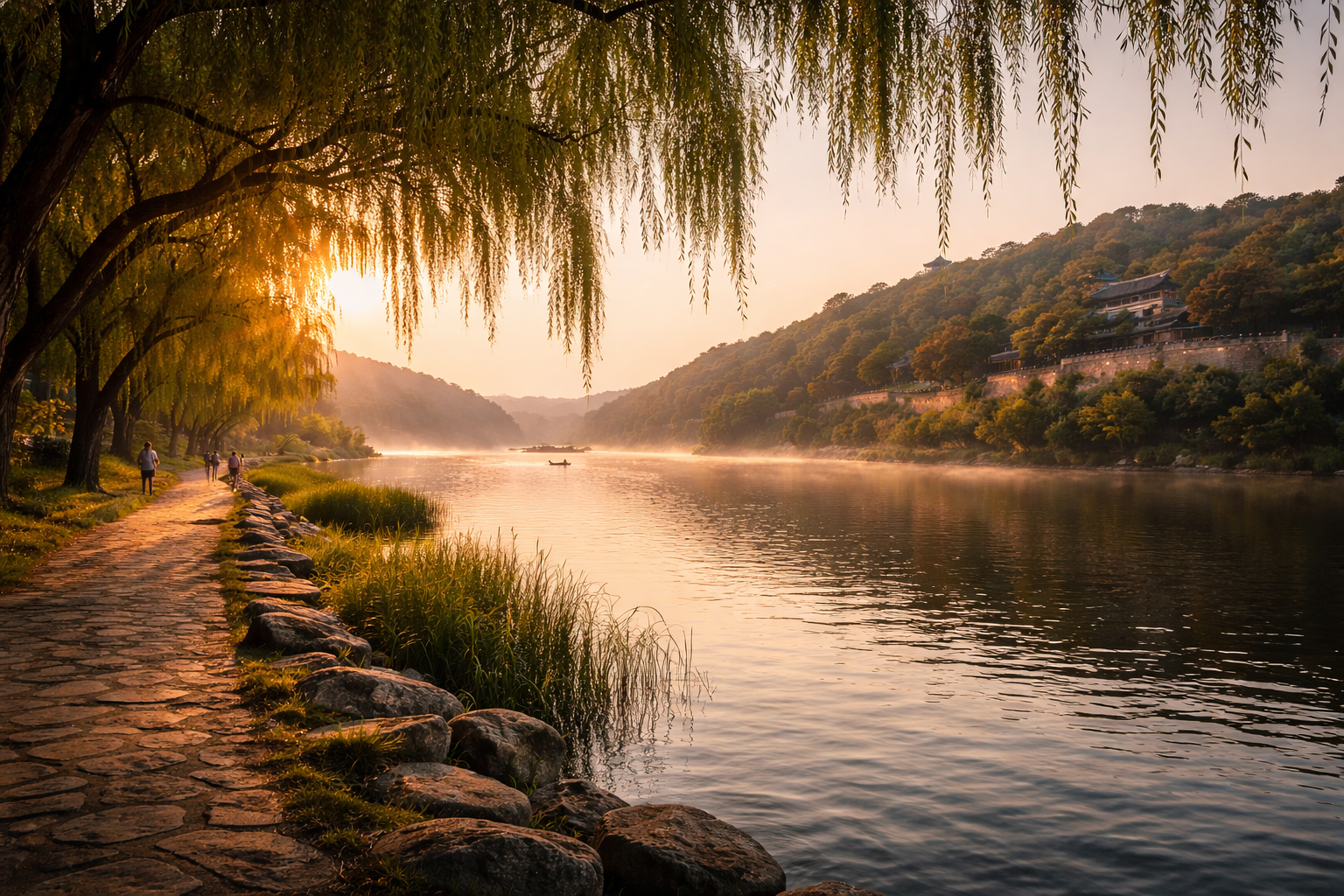
The first thing you notice isn’t “wow architecture.” It’s space. Buyeo opens up around the water—wide sky, soft fields, and a slower rhythm.
If you arrive in the morning, the air can feel crisp and slightly damp, the kind of weather that makes you walk longer than planned.
Late afternoon is the other sweet spot: warmer color, gentler shadows, and a calmer mood if you want photos that feel cinematic without trying too hard.
Easy Walking Flow (No Stress)
- Start with 20–30 minutes along the river to “set the pace.” Don’t rush into museums first.
- Pick one photo viewpoint (bridge angle, open meadow stretch, or a calm bend in the water).
- Add Baekje context after—museum or cultural complex—so the scenery has meaning.
- Finish with a snack break (something warm if it’s windy) and one more short stroll.
Key Information
| Location | Buyeo-gun, Chungcheongnam-do, South Korea |
|---|---|
| Hours | Open year-round (best at sunrise / late afternoon) |
| Admission | Free (river paths); museums/parks may charge separately |
| Best Seasons | Spring (Apr–Jun) and Autumn (Sep–Nov) |
| Getting There | Express bus to Buyeo Bus Terminal → taxi/local transit to riverside access points |
| Best For | Families, seniors, photographers, cyclists, slow-travel itineraries |
Baekje Context: Why This River “Belongs” to Buyeo
Buyeo’s identity is inseparable from Baekje’s Sabi period. That’s why the river scenery hits differently here:
you’re not just looking at water—you’re moving through a landscape that supported settlement, travel, and memory in the old capital region.
Many route guides describe Baekma/Baengma River as a notable Buyeo segment tied to heritage viewpoints and bike routes.
If you want the “story version” of the river day, pair your walk with a Baekje-focused museum stop.
Buyeo National Museum is widely introduced as a Baekje-culture-centered institution and a key place to understand the region before (or after) you stroll.
Tips & Warnings (Real-World)
Tip: Make the River Feel “Worth It”
Don’t treat Baengma River as a 10-minute photo stop. Give it at least 45 minutes of moving time.
Walk until you feel your shoulders drop—then take photos. That’s the whole point of this place.
Tip: The Best Light Trick
If you can’t do sunrise, aim for 60–90 minutes before sunset. The river turns softer, the fields get warmer color,
and your photos look like you planned them (even if you didn’t).
Warning: Wind + Open Space = “Colder Than Expected”
Even in mild seasons, river wind can turn a comfortable walk into a chilly one fast.
Bring a light layer—especially if you’re doing the riverside stretch near dusk.
A vs B: Which Buyeo Experience Should You Prioritize?
If you only have half a day, don’t try to “do everything.” Choose the mood you want—then build the rest around it.
| Option | Best For | What It Feels Like | My Pick If… |
|---|---|---|---|
| A) Baengma River Walk | Slow travel, families, photos, reset-day | Quiet, open, meditative | You want calm + space more than “big sights.” |
| B) Heritage + Viewpoint Focus (Museum / Baekje Cultural Land + one viewpoint) |
History lovers, first-time Buyeo visitors | Meaning-first: scenery becomes a story | You want to understand Buyeo quickly and leave with a clear narrative. |
Half-Day & Full-Day Plan
Half-Day (3–4 Hours)
- Baengma River walk (60–90 min) — choose one long stretch, don’t zigzag.
- Buyeo National Museum (60–75 min) — just enough to anchor the story.
- Café / snack + short river finish (30 min) — end slow, not rushed.
Full Day (5–7 Hours)
- Morning river (90 min) — best light, best mood.
- Baekje Cultural Land / Complex (2–3 hrs) — time-machine vibe for Baekje culture.
- Festival-season bonus — if you’re visiting in early October, check Baekje Cultural Festival timing.
- Sunset river finish (30–45 min) — the “why this place matters” moment.
Best Time to Visit (Festivals & Seasons)
Spring and autumn are the easiest choices for walking comfort. If you want peak “Buyeo energy,” autumn festival season is your window:
the Baekje Cultural Festival is generally described as held around late September to early October, alternating between Buyeo and Gongju.
Summer can be lush but warmer; winter is quiet and photogenic in a minimalist way—just pack for wind on open river stretches.
How to Get There
- From Seoul: express bus to Buyeo Bus Terminal (roughly 2.5 hours), then taxi/local transit to riverside access points.
- By car: easiest for flexible river entry points; parking is usually available near riverside parks.
- Local movement: taxis are practical for short hops if you’re bundling museum + river + one extra stop.
Nearby Attractions That Actually Pair Well
- Buyeo National Museum: a clean, high-impact context stop for Baekje culture.
- Baekje Cultural Land (Cultural Complex): big-scale Baekje themed park/complex, great if you like immersive heritage spaces.
- One viewpoint / story spot: if you want a “legend + scenery” angle, Buyeo’s wider area is known for Baekje-era story viewpoints.
FAQ
How long should I spend at Baengma River?
Is it family-friendly?
What’s the best season?
Is Baengma River the same as Baekma River?
Official Links (Trusted Sources)
- Buyeo County Official Website
- Buyeo National Museum (Official) :contentReference[oaicite:13]{index=13}
- Baekje Cultural Land / Baekje Heritage (Official)
- Korea Tourism Organization (KTO)
Related Posts (Trip Nexus)
Google Map
Final Take
Baengma River is Buyeo’s “quiet power.” Don’t over-plan it—just give it time, light, and one good heritage pairing.
If you want the most satisfying day, choose B: river first for mood, then museum/heritage for meaning.