Thailand Arrival Guide 2026: Immigration, Visa, Customs, and Global Entry Planning Hub
Thailand Arrival Guide 2026 starts the moment you leave the aircraft and follow the signs toward immigration. These signs might remind you of the airport-themed design of places like Terminal 21 Pattaya, which many travelers visit without realizing what actually makes it worth it. For many travelers, this part of the trip feels simple on paper but messy in real life. Long corridors, sudden queues, document checks, biometric cameras, baggage claim, customs, and transport all happen in sequence, and small mistakes can easily turn a smooth arrival into an exhausting first hour. Since May 2025, all foreign nationals entering Thailand by air must complete the Thailand Digital Arrival Card (TDAC) before arrival, replacing the old paper TM6 card. The process asks for patience more than preparation.
This page is designed as a practical arrival and visa hub: first, it explains the Thailand airport arrival process step by step; then it connects you to country-specific visa and entry guides for Singapore, Malaysia, Japan, Turkey, Poland, Norway, Greece, Vietnam, and Thailand’s TDAC system.
I have always felt that airport arrival guides are most useful when they explain the real sequence, not just the official rules. The goal here is simple: help you move from aircraft door to immigration, baggage claim, customs, and onward transport without wasting time or making avoidable mistakes. The official rules get you through the door; the real sequence gets you through the line.
Search Intent
This guide is for travelers arriving in Thailand who want to understand the full airport arrival flow, avoid immigration mistakes, prepare the right documents, clear customs properly, and compare Thailand’s entry process with other visa and arrival systems before planning a wider trip. Most guides skip the customs part—this one doesn’t.
Why Thailand Arrival Feels Easy for Some Travelers and Hard for Others
The difference between a smooth arrival and a frustrating one is usually not the officer, the airport, or even the queue length. It is preparation. Travelers who arrive organized often pass through quickly, while travelers who look uncertain tend to attract extra questions or lose time searching for basic information.
Thailand’s airport system is generally structured and predictable. The problem is that many people only think about the arrival process after landing. By then, they are tired, moving with a crowd, and trying to remember details they should already have ready.
I learned this the annoying way: the airport itself wasn’t hard, but fumbling for an address while everyone behind me kept moving made the whole moment feel way more stressful than it needed to be. Now I keep hotel details, onward tickets, and entry confirmations in one offline folder before I even board. That minute of scrambling costs more in composure than the five minutes of prep would have.
What It Feels Like in Real Life
The first thing you notice after landing in Thailand is that the arrival process starts before you feel mentally ready. You leave the plane, follow the crowd, and suddenly you’re already in the immigration stream. Pause too long or start organizing documents too late, and the line grows around you fast. Your feet are still adjusting to solid ground while your hands are already reaching for a passport.
The system isn’t especially complicated, but it moves fastest when you’re one step ahead. That means knowing your hotel address, keeping your passport in hand, and not assuming you can “sort it out later.” A few seconds of prep now saves more than a few minutes of frustration later.
One of the easiest mistakes is underestimating how quickly airport momentum builds. Once several flights land close together, even a small delay on your end can snowball into a much longer wait. The delay you think is small is the one that compounds fastest.
Step-by-Step Thailand Airport Arrival Process (2026)
Step 1) Leave the Aircraft and Follow Immigration Signs
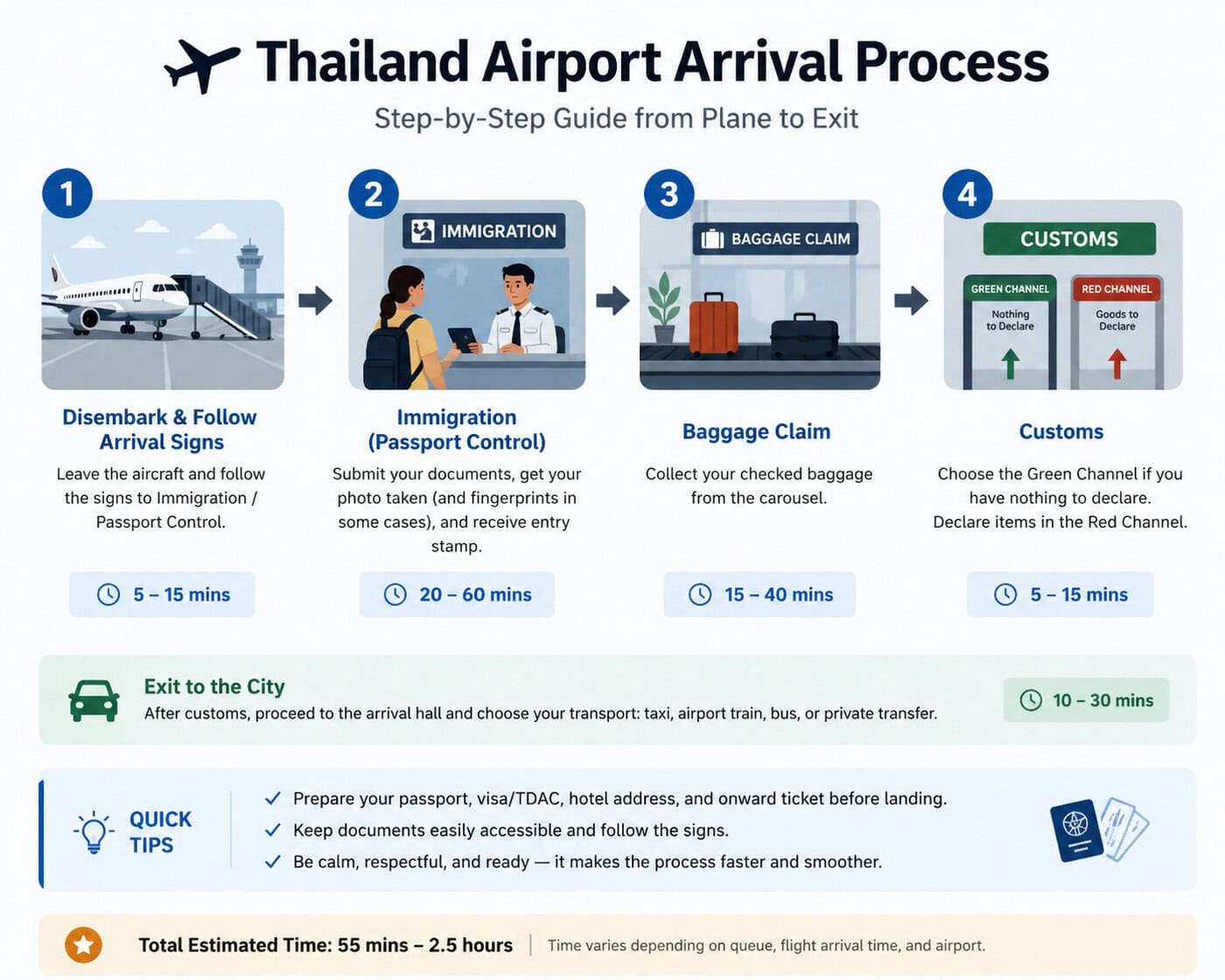
After disembarking, follow the signs for Immigration, Passport Control, or Arrivals. At larger airports such as Suvarnabhumi (BKK), this may involve long corridors, escalators, moving walkways, or internal transfers before you even reach the immigration hall. The sheer number of people is a good preview of the crowds you’ll encounter at places like the Grand Palace Bangkok, where timing can change everything.
Step 2) Prepare Your Documents Before Joining the Queue
Before you enter line, make sure these are ready:
- Passport
- Visa or eVisa confirmation, if required
- Hotel or accommodation name and address
- Return or onward ticket details
- Thailand Digital Arrival Card (TDAC) confirmation, if required
Reality check: A prepared traveler usually receives fewer questions because the answers match the documents immediately.
Step 3) Complete the Thailand Digital Arrival Card (TDAC) if Required
Thailand uses the Thailand Digital Arrival Card (TDAC) for many foreign travelers. The form is submitted online before arrival and includes key information such as passport details, flight number, address in Thailand, and travel purpose.
If you are entering Thailand formally, treat TDAC as part of your arrival preparation rather than something to think about at the last minute. For a deeper walkthrough, use the Thailand Digital Arrival Card (TDAC) Guide.
Step 4) Choose the Correct Immigration Lane
Most airports divide arrivals into lanes such as:
- Thai Citizens / Residents
- Foreign Passport Holders
- Fast Track / Premium / Priority lanes
Standing in the wrong lane can waste a surprising amount of time. If you are not sure, ask a staff member right away instead of guessing.
Step 5) Biometrics: Photo and Sometimes Fingerprints
At many international arrival points, biometric checks are normal. That often means a camera photo and sometimes fingerprints.
- Stand still when the photo is taken
- Look straight ahead
- Follow the officer’s instruction first
- Keep your expression neutral
Step 6) Immigration Questions Are Usually Short
Most questions are simple and direct:
- What is the purpose of your visit?
- How long will you stay?
- Where will you stay?
- Do you have a return ticket?
Best strategy: answer briefly and consistently with your documents. If you want more examples, read the Airport Immigration Process Guide.
Step 7) Check Your Entry Approval Before Walking Away
Once approved, take a few seconds to make sure the result is correct. Check the entry date, the permitted duration of stay, and any relevant visa notes if applicable.
Step 8) Baggage Claim and Customs
After immigration, proceed to baggage claim, collect your luggage, and continue to customs. This is the normal arrival sequence before entering the public arrivals area.
- Green Channel: Nothing to declare
- Red Channel: Goods to declare
If you are unsure whether an item should be declared, check before flying instead of assuming it will be fine.
From Thailand Arrival Guide to Global Visa Planning
Thailand is only one version of the arrival puzzle. Once you start planning multi-country travel, the same basic pattern repeats: entry permission, arrival form, passport validity, onward travel proof, customs rules, and local airport flow.
The details change by country. Singapore and Malaysia may feel streamlined for many travelers, Japan can require more careful checking depending on nationality, and European destinations like Poland, Norway, and Greece may involve Schengen-area rules. Turkey has its own entry logic, while Vietnam’s arrival process can feel different again for first-time visitors.
That is why this page works best as a hub: start with Thailand if you are landing there, then use the country guides below to prepare the rest of your route.
Entry & Visa Guide Hub: Choose Your Next Country
Visa vs Arrival System: What Travelers Often Confuse
What Actually Makes Thailand Entry Faster
Most airport guides stop at the rule list, but real arrivals depend just as much on how prepared you look. Officers are processing large numbers of travelers quickly, so confidence and clarity matter.
In practice, the travelers who get slowed down are often the ones who cannot find their hotel address, do not know their onward flight date, or start giving answers that do not match what is on their booking. The process does not need perfect English or perfect confidence, but it does reward consistency.
The easiest time saver is simple: keep your key arrival details in one place before landing. That one habit solves more problems than most people realize.
Real Travel Tips and Mistakes to Avoid
- Save your hotel booking, return ticket, and entry confirmation as screenshots before boarding.
- Do not wait until the counter to search your email for your accommodation address.
- If you are tired after a long flight, slow your mind down but keep your documents ready.
- If something is unclear, ask airport staff before standing in the wrong queue.
- Never assume customs is irrelevant just because you are a tourist with a normal suitcase.
- For multi-country trips, check each destination’s visa or arrival guide before you book non-refundable flights.
WARNING: If you are carrying anything unusual, expensive, regulated, or possibly restricted, check the official customs rules before departure. Guessing is a bad strategy at the airport.
Customs and Restricted Items: Where Travelers Get Careless
One common mistake is treating customs like a formality. In reality, customs is the last important checkpoint before you fully enter the country. If you are carrying something that should be declared, assuming the Green Channel is always safe can create unnecessary problems.
I would not rely on random forum advice here. Customs rules are one of those areas where official guidance matters far more than traveler gossip. If you are unsure about quantities, restricted goods, or declaration rules, verify before departure.
The smartest approach is simple: if there is any doubt, check first and choose the correct channel on arrival.
BKK vs DMK Arrival Experience
My take: if you want a smoother infrastructure experience, BKK usually feels better. If you prefer a more compact arrival, DMK can feel easier. In real life, timing matters almost as much as airport choice.
Who This Hub Helps Most
- First-time visitors arriving in Thailand for tourism
- Travelers worried about immigration questions or airport confusion
- People landing at BKK or DMK who want a clearer first-hour plan
- Visitors carrying multiple bookings, eSIM plans, or onward travel arrangements
- Multi-country travelers comparing Thailand, Vietnam, Singapore, Malaysia, Japan, Turkey, or Europe entry requirements
- Anyone who wants to enter faster without paying for premium services
FAQ
Do I need the Thailand Digital Arrival Card in 2026?
Many foreign travelers should complete the TDAC before entering Thailand. Check your exact case before flying rather than assuming it does not apply.
What documents do immigration officers usually ask for?
Your passport is essential. Depending on your case, officers may also ask for your hotel address, visa or eVisa details, and your return or onward ticket.
How long does Thailand immigration usually take?
That depends heavily on airport timing. Quiet arrival periods can be quick, while large arrival waves can make the process much longer.
Is a visa guide the same as an arrival guide?
No. A visa guide explains whether you can enter and what permission you need. An arrival guide explains what happens at the airport or border once you reach the country.
Which guide should I read after this Thailand arrival guide?
If Thailand is your next destination, read the TDAC guide. If you are planning a wider trip, use the Singapore, Malaysia, Japan, Turkey, Poland, Norway, Greece, or Vietnam guides in the hub section above.
What should I do if I am unsure about customs?
Check official customs guidance before departure. If there is any doubt, do not rely on assumptions.
Official Links
Final Thoughts
Thailand Arrival Guide 2026 becomes much simpler once you stop seeing arrival as one vague airport moment and start seeing it as a sequence: immigration, baggage claim, customs, and transport. Once that sequence is clear, the whole process feels less stressful.
But the larger lesson applies beyond Thailand. Every country has its own entry rhythm. The smartest travelers are not the ones who memorize every rule; they are the ones who check the right guide before they fly and keep the right details ready before landing.
Next step: use this page as your entry hub. Start with the Thailand TDAC Guide, then compare your next destination with the Singapore, Malaysia, Japan, Turkey, Poland, Norway, Greece, Vietnam, and airport immigration guides above.