Castel Sant’Angelo Rome Guide (2026): Tickets, Terrace Views, What to Expect, and Is It Worth Visiting?
Castel Sant’Angelo is one of the most visually striking landmarks in Rome, but what makes it worth visiting is not just the fortress-like exterior. This place gives you Roman imperial history, papal intrigue, prison stories, museum collections, and one of the best terrace views in the city in a single visit. I think that mix is exactly why it stays in people’s memory longer than many bigger-name attractions.
Search Intent
This guide is for travelers searching for the best way to visit Castel Sant’Angelo in Rome, including opening basics, ticket strategy, what to see inside, how long to stay, when to go, nearby stops, and whether it is worth your time compared with other major Rome attractions.
Quick Summary
- Castel Sant’Angelo combines a mausoleum, fortress, papal refuge, prison, and museum in one site.
- It sits near the Vatican and is easy to pair with St. Peter’s Basilica, Ponte Sant’Angelo, and central Rome walking routes.
- Plan about 2 to 3 hours if you want the main rooms, terrace, and photos without rushing.
- The terrace panorama is one of the strongest reasons to go, especially later in the day.
- Booking ahead is the safer choice because timed entry and busy periods can affect the experience.
Why Castel Sant’Angelo Is Worth Visiting
Rome has no shortage of famous monuments, so the real question is not whether Castel Sant’Angelo is historic. Of course it is. The better question is whether it gives you something different from the Colosseum, Roman Forum, or Vatican Museums. My answer is yes. Castel Sant’Angelo feels more layered, more enclosed, and honestly more dramatic. Instead of a single identity, it has had several lives: imperial tomb, military stronghold, papal fortress, prison, and museum. You are not just visiting a building. You are moving through centuries of reinvention.
That is what gives the place its unusual atmosphere. The exterior looks compact and defensive, but once you enter, the experience keeps shifting. One level feels heavy and military, another feels ceremonial, another unexpectedly elegant. The contrast is part of the appeal. You start with ancient Rome and end with wide-open views over the city, which makes the visit feel bigger than the footprint suggests.
If you like monuments that tell a clean, simple story, this may not be your favorite. But if you enjoy places where history overlaps and the building itself feels like evidence, Castel Sant’Angelo is excellent. I would put it high on the list for travelers who want one Rome attraction that is both visually memorable and historically dense.
What It Feels Like Inside
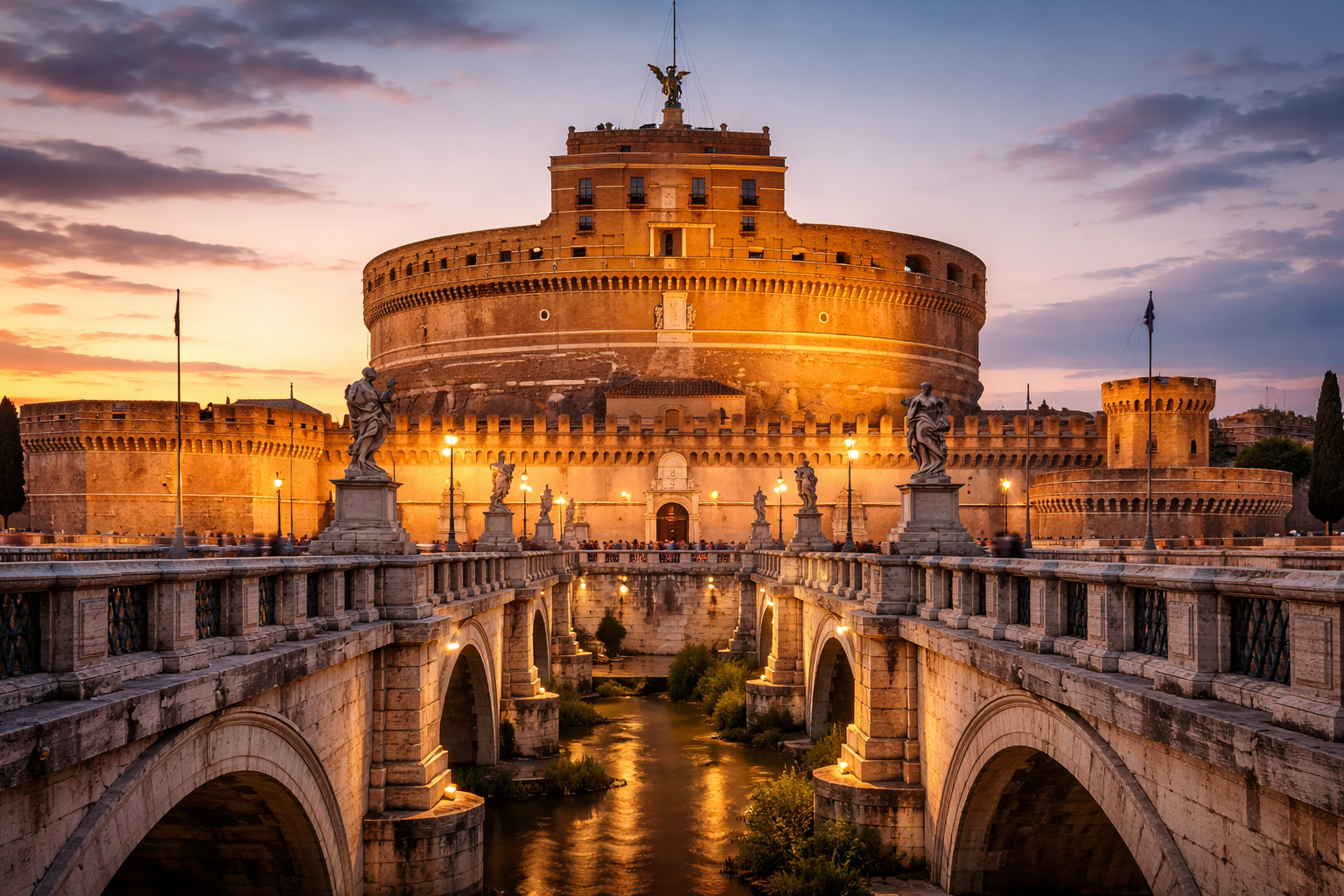
Crossing Ponte Sant’Angelo already changes your mood. The bridge gives you one of those classic Rome approach shots that almost feels too cinematic to be real, especially when the light softens near sunset. Then you enter the fortress and the city noise suddenly drops. That shift is important. Castel Sant’Angelo does not feel airy and open in the same way as a basilica or piazza. It feels heavier, quieter, and more controlled.
I like that it never turns into a flat museum walk. You move through ramps, corridors, chambers, thicker walls, and terrace zones that make you physically feel the building’s defensive logic. At times it feels imperial, at times papal, and at times almost claustrophobic. That emotional variety is what makes the site strong. You are not just looking at objects in cases. You are reading the structure itself.
One mistake visitors make is assuming this will be a short viewpoint stop with a few historical rooms attached. It is better than that, but only if you give it enough time. If you rush to the terrace and skip the interior sequence, you miss the reason the view feels earned.
Key Visitor Information
| Location | Lungotevere Castello 50, 00193 Rome, Italy |
|---|---|
| Official Site | direzionemuseiroma.cultura.gov.it |
| Ticket Booking | Advance booking is recommended, especially on weekends and holidays |
| Current Price Reference | Full ticket from €12 on official tourism information pages; always recheck before visiting |
| Opening Basics | Timed entry is used; check the official page for your exact travel date and latest schedule |
| Recommended Visit Duration | 2 to 3 hours |
| Nearest Area | Near the Vatican, Ponte Sant’Angelo, and the Tiber riverside |
| Public Transport | Easy access from central Rome on foot, bus, or metro plus a short walk |
Insider Tip
If you can, visit later in the day rather than at midday. The terrace views are more rewarding, the light is softer for photos, and the whole monument feels more atmospheric when Rome starts to glow instead of glare.
Top Things to See Inside Castel Sant’Angelo
1. The Spiral Access and Fortress Interior
The internal circulation is part of the attraction. The paths, ramps, and defensive feel remind you that this was never just a decorative monument. Pay attention to how the building shapes your movement. That is part of the story.
2. The Papal Apartments
These rooms create one of the most interesting contrasts in the whole site. After the heavier military and stone-filled sections, the more refined papal spaces suddenly add color, art, and political meaning. They show how the building shifted from tomb to stronghold to residence.
3. Prison and Power History
This is where Castel Sant’Angelo becomes more than a scenic stop. The prison associations and stories of intrigue give the building its darker identity. Even when the rooms are visually plain, the history behind them adds tension.
4. The Terrace
The terrace is the payoff. You get open views of the Tiber, the rooftops of Rome, and the dome of St. Peter’s in the distance. It is one of those moments where the city suddenly makes sense geographically. I would not skip it for anything.
Warning
Do not wear slippery shoes or treat this like a fully flat indoor museum. Parts of the route involve stairs, ramps, uneven surfaces, and a more fortress-like layout than many first-time visitors expect.
Best Time to Visit Castel Sant’Angelo
Late afternoon is usually the sweet spot for this monument. Turismo Roma specifically highlights the appeal of the terrace and the surrounding panorama at sunset, and that matches the actual traveler experience very well. The building simply looks better when the light gets warmer, and the city skyline becomes more atmospheric instead of washed out.
That said, timing depends on what kind of visitor you are. If you care most about quieter circulation indoors, earlier slots can feel more comfortable. If you care most about photography and rooftop mood, later is better. I usually think the second option wins here because the terrace is one of the fortress’s strongest assets.
Summer can make central Rome draining, so combining Castel Sant’Angelo with a later-day visit also helps with comfort. You do not want your energy disappearing before you even reach the upper sections.
How to Get There
Castel Sant’Angelo is in a very convenient part of Rome for first-time visitors. It sits on the right bank of the Tiber near the Vatican area, so it fits easily into a walking route that includes St. Peter’s Basilica, Borgo Pio, and the riverside. If you are already sightseeing in central Rome, you may not need a complicated transport plan at all.
Metro and bus connections are workable, but I think the best arrival is on foot if your schedule allows it. Approaching across Ponte Sant’Angelo is not just practical; it is part of the experience. You get the monument building itself in front of you, the bridge sculpture sequence, and the slow reveal of the fortress walls. Rome rarely does understated entrances, and this is one of its better ones.
A vs B: Castel Sant’Angelo or Another Major Rome Monument?
| Type of Traveler | Castel Sant’Angelo | Vatican Museums / Colosseum Type Sites |
|---|---|---|
| First-time Rome visitors | Great add-on with strong visuals and easier pacing | Usually bigger headline attractions |
| History lovers | Excellent for layered history and architecture | Excellent, but often more crowded and intense |
| Photo-focused travelers | Very strong because of bridge and terrace views | Strong, but often busier and harder to shoot calmly |
| Short city-break travelers | Good if paired with Vatican-side sights | May require more schedule commitment |
My honest take: if you already have the Colosseum and Vatican Museums on your itinerary, Castel Sant’Angelo still earns its place because it adds a different mood. It feels more strategic, more secretive, and more intimate in its storytelling.
Suggested Visit Plan
- Book your ticket ahead and double-check the latest official entry rules.
- Arrive on foot if possible, ideally via Ponte Sant’Angelo.
- Take your time through the internal route instead of rushing straight to the terrace.
- Pause in the papal sections to understand how much the building changed over time.
- Finish on the terrace when the light starts improving.
- Afterward, continue toward Borgo Pio or the Vatican area for food or another short stop.
Nearby Attractions and Easy Pairings
Ponte Sant’Angelo is the obvious first pairing, and it is not just “nearby” in a checklist sense. It is part of how the monument is experienced. The angel statues and long bridge perspective give the fortress a dramatic arrival frame.
St. Peter’s Basilica is close enough that the two sights naturally belong in the same part of a Rome itinerary, though I would not cram both into a rushed time block if you want to enjoy them properly.
Borgo Pio works well for food afterward. If you want a softer, more local-feeling finish after stone walls and museum rooms, that area gives you a nice rhythm change.
Who Should Visit
- travelers who like architecture with real historical tension
- visitors wanting one excellent viewpoint without skipping culture
- Rome first-timers building a Vatican-side walking day
- return visitors looking for a major sight with a different atmosphere
- people who enjoy museums more when the building itself tells the story
What Makes Castel Sant’Angelo Unique
Very few monuments in Rome embody so many identities at once. Castel Sant’Angelo began as Hadrian’s mausoleum, evolved into a fortress, became linked to papal survival through the Passetto di Borgo, and later took on a museum role. That sequence matters because it means the monument does not feel frozen in one era. It feels adapted, reused, and politically charged.
That is why the place lingers. You are not leaving with just one image. You leave with several: the cylindrical mass from the riverbank, the enclosed interior paths, the papal rooms, the defensive edge, the bridge approach, and the final terrace panorama. Some attractions give you one perfect postcard. Castel Sant’Angelo gives you a full historical mood.
I also think it captures something very Roman: the city’s habit of layering power over power, function over function, century over century. It is not polished into simplicity, and that is exactly why it works.
Related Internal Guides
Official and Authoritative Resources
FAQ
Is Castel Sant’Angelo worth visiting in Rome?
Yes. It is one of Rome’s most interesting multi-layered monuments because it combines ancient history, papal history, a museum route, and excellent terrace views.
How long do you need at Castel Sant’Angelo?
Most travelers should allow 2 to 3 hours. That gives enough time for the interior route, papal rooms, and the terrace without feeling rushed.
What is the best time to visit Castel Sant’Angelo?
Late afternoon is often the most rewarding because the terrace views and the light over Rome are especially beautiful then.
Do I need to book Castel Sant’Angelo tickets in advance?
It is strongly recommended, especially on weekends, holidays, and high-season travel dates.
Is Castel Sant’Angelo near the Vatican?
Yes. It is very close to the Vatican area and pairs naturally with St. Peter’s Basilica and nearby walking routes.
Can you see good views from Castel Sant’Angelo?
Absolutely. The terrace is one of the monument’s highlights and gives memorable views of Rome, the Tiber, and St. Peter’s dome.
Is Castel Sant’Angelo better than the Vatican Museums?
They offer different experiences. The Vatican Museums are larger and more collection-heavy, while Castel Sant’Angelo feels more architectural, strategic, and panoramic.
Should I check the official site before visiting?
Yes. Always recheck the latest schedule, ticketing rules, and special access information before your visit.
Quick Summary
1. Castel Sant’Angelo is one of Rome’s most layered and atmospheric monuments.
2. The terrace view is a major highlight, especially later in the day.
3. Give it 2 to 3 hours and do not skip the interior sequence.
4. It pairs perfectly with the Vatican side of Rome.
5. If you want history, views, and strong atmosphere in one place, this is an easy yes.
Google Map
Final Verdict
If you are choosing between “important” and “actually memorable,” Castel Sant’Angelo gives you both. I would not rank it as Rome’s loudest attraction, but I would absolutely rank it as one of the city’s smartest ones.
It is especially good for travelers who want a place that feels historical, strategic, visual, and unmistakably Roman all at once.