ITALY · ROME
Circus Maximus Rome Guide: What You Actually See, Best Views, and When to Go
Circus Maximus Rome is one of the largest ancient stadiums in history, where chariot races once defined Roman entertainment and power.
Search IntentThis guide helps you understand what Circus Maximus actually looks like today, whether it’s worth visiting, and how to experience the best views and historical perspective without wasting time.
Quick Summary
- Circus Maximus Rome is the largest stadium of Ancient Rome, once holding over 150,000 spectators.
- Today, it is a public park with visible ruins and powerful historical atmosphere.
- Best visited early morning or sunset for lighting and fewer crowds.
- Perfect viewpoint for Palatine Hill and Rome skyline photos.
- Free entry makes it one of the highest value spots in Rome.
Circus Maximus Rome is not just an empty field—it is one of the most historically powerful places in the city. Standing here, I initially felt underwhelmed. It looked too simple. But within minutes, something shifted. The scale started to make sense. The silence felt heavy. And suddenly, I could imagine the roar of 150,000 people filling this space.
This is where ancient Rome truly comes alive—not through preserved marble, but through raw space and imagination. And that’s exactly why Circus Maximus is worth visiting.
Why Circus Maximus Still Matters
Unlike the Colosseum, Circus Maximus doesn’t overwhelm you with intact structures. Instead, it gives you something more subtle—but arguably more powerful: scale. This was the center of Roman mass entertainment, political messaging, and imperial spectacle.
It wasn’t just racing. It was propaganda, celebration, and control—all happening in one massive space.
What It Feels Like
Walking across the grass, I noticed something strange—there was almost no noise. Just distant traffic and wind. That contrast made it even more intense. You’re standing in what used to be the loudest place in Rome, now completely quiet.
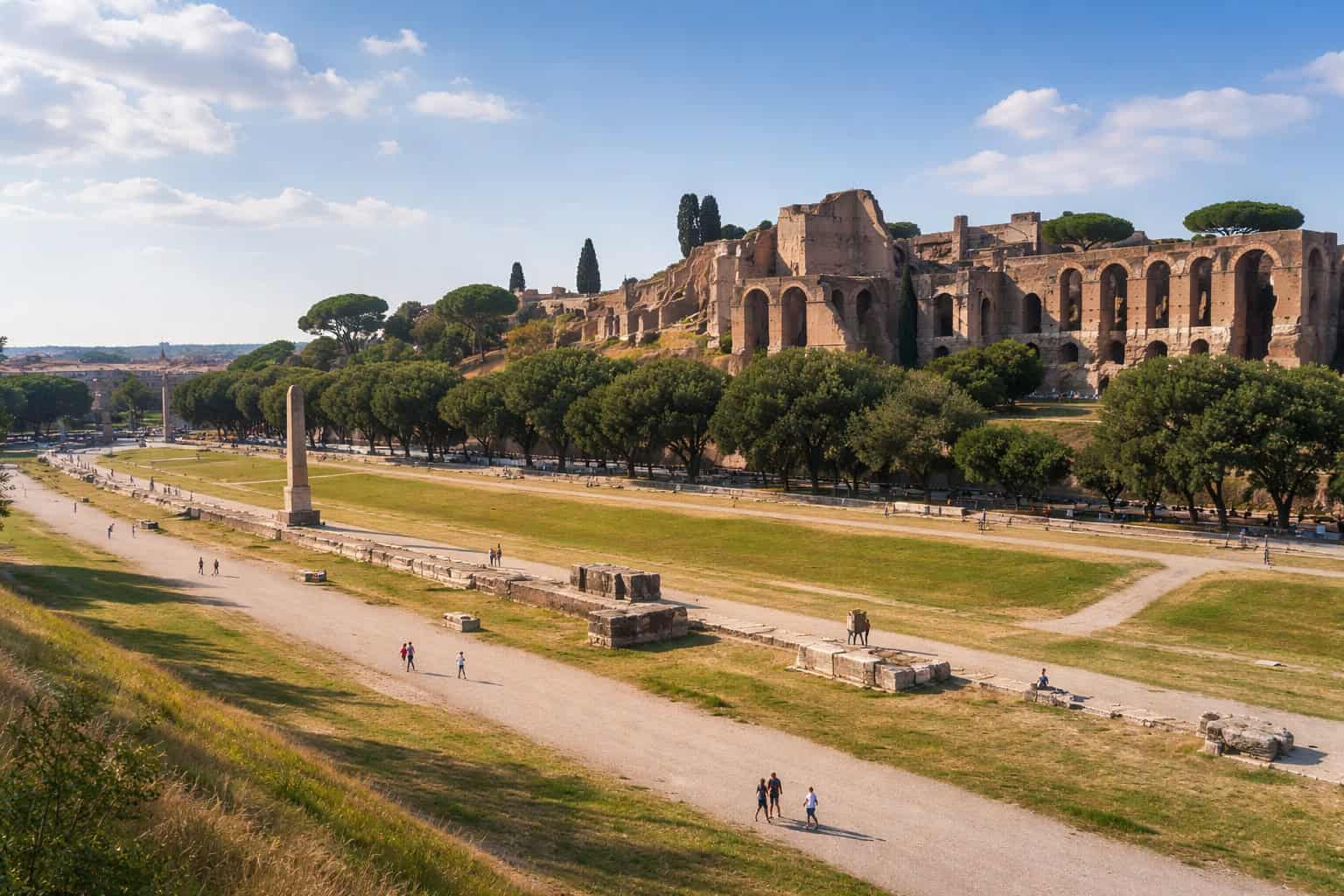
The Palatine Hill rises above you, almost watching over the arena. That perspective alone makes this place different from every other Roman site.
History & Background
The Circus Maximus dates back to the 6th century BCE and became Rome’s largest entertainment venue. At its peak, it could host over 150,000 spectators—far surpassing the Colosseum.
It evolved from a simple wooden racetrack into a monumental stone structure under Julius Caesar and later emperors. The central divider, called the spina, was decorated with obelisks, statues, and fountains, creating both spectacle and symbolism.
Main Highlights
Spina (Central Track)
The spine of the arena where races were centered. Today, only fragments remain, but the layout is still visible.
Palatine Hill Viewpoint
This is the real highlight. From here, you can see the entire Circus Maximus shape and understand its massive scale.
Pulvinar (Emperor’s Box)
The VIP section where emperors watched races. Even in ruins, the elevated position gives a strong sense of authority.
Key Visitor Information
| Opening Hours | 24 hours (public park) |
| Entrance Fee | Free |
| Location | Piazza del Circo Massimo, Rome |
| Best Time | Early morning or sunset |
| Transport | Metro B – Circo Massimo |
Travel Tips (Real Experience)
Recommended Route
- Start at Metro Circo Massimo
- Walk through central field
- Head toward Palatine Hill viewpoint
- Finish near Aventine side for skyline views
Circus Maximus vs Colosseum
| Feature | Circus Maximus | Colosseum |
| Structure | Mostly open space | Fully preserved |
| Experience | Atmospheric | Visual impact |
| Crowd | Low | High |
| Cost | Free | Paid |
FAQ
Is Circus Maximus worth visiting?
Yes, especially for views and historical context.
How long should I stay?
30–60 minutes is enough.
Is it free?
Yes, completely free.
Can you see ruins?
Yes, but mostly foundational remains.
Location
Final Thought
If you skip Circus Maximus, you’ll miss something subtle but powerful. It’s not about what you see—it’s about what you feel. And that feeling is what makes Rome unforgettable.