Tucked away in the heart of Vatican City lies a masterpiece that has drawn millions of curious eyes and wander-laden feet through its doors—7 St. Peter’s Basilica. This iconic landmark, with its awe-inspiring architecture and profound history, is much more than just a grand structure; it’s a tapestry of art, faith, and culture interwoven over centuries. Whether you’re a devout pilgrim or a curious traveler, the basilica offers a glimpse into the soul of Vatican City, where every corner whispers stories of an era long past yet vividly alive.
Imagine standing beneath the gigantic dome, designed by the genius Michelangelo, feeling the weight of history pressing around you as you gaze at the intricate mosaics and paintings gracing its walls. As we embark on this journey through 7 St. Peter’s Basilica, we’ll uncover the marvels that make this site an unparalleled treasure trove of religious and cultural significance. From its storied past to the celebrated works of art housed within, this guide will enlighten you with the must-see attractions and practical tips to make your visit unforgettable. Join us as we delve into one of the most revered sites in the world, where faith meets art in a harmonious embrace.
The History Behind St. Peter’s Basilica
Long before the present basilica rose from the marble quarries, the first St. Peter’s was commissioned by Emperor Constantine around AD 320. Built over what was believed to be the tomb of Saint Peter, one of Jesus’s apostles, the Constantinian structure served as a focal point for early Christians. Over the centuries, the original church fell into disrepair, and by the late 15th century, popes envisioned a grander temple befitting the center of Catholicism. This vision culminated in the construction of 7. St. Peter’s Basilica – Vatican City, which commenced in 1506 under Pope Julius II and spanned over 120 years of design tweaks, political intrigue, and funding challenges.
Key Renaissance masters—Bramante, Raphael, Sangallo, and Michelangelo—each left their mark on the project, contributing to the layered architectural narrative you see today. The finished basilica was consecrated by Pope Urban VIII in 1626, boasting a colossal façade, one of the largest interior spaces of any church in the world, and a dome that dominates Rome’s skyline. As you walk through its vast nave, you’re literally treading on centuries of artistic ambition and religious devotion, a journey from Constantine’s humble chapel to the monumental symbol of the Catholic faith that millions visit each year.
Michelangelo’s Magnificent Dome: A Masterpiece Unveiled
Michelangelo inherited a design that was already in progress when he was appointed chief architect in 1547. Unwilling to scale down the magnitude of the project, he reimagined Bramante’s original plan and raised the dome to soaring new heights. Completed after his death in 1590, the hemispherical dome stretches 136.57 meters to its highest point and boasts an inner diameter of over 41 meters—an engineering marvel that remained unmatched for centuries.
On-site, you’ll notice the dome’s double-shell design, a pioneering solution to lessen weight while maintaining structural integrity. Visitors can climb 551 steps to reach the base of the dome—about 8 minutes on foot if you move steadily—and be rewarded with panoramic views of Vatican City, Rome’s historic center, and the Tiber River. Inside, the golden mosaics depict saints, prophets, and allegorical figures, their tesserae shimmering in the natural light filtering through the oculus. A must-see detail: look for Michelangelo’s simple inscription “MICHAELAN” near the lantern, a humble signature on his boldest achievement.
The Piazza San Pietro: The Heart of Vatican City
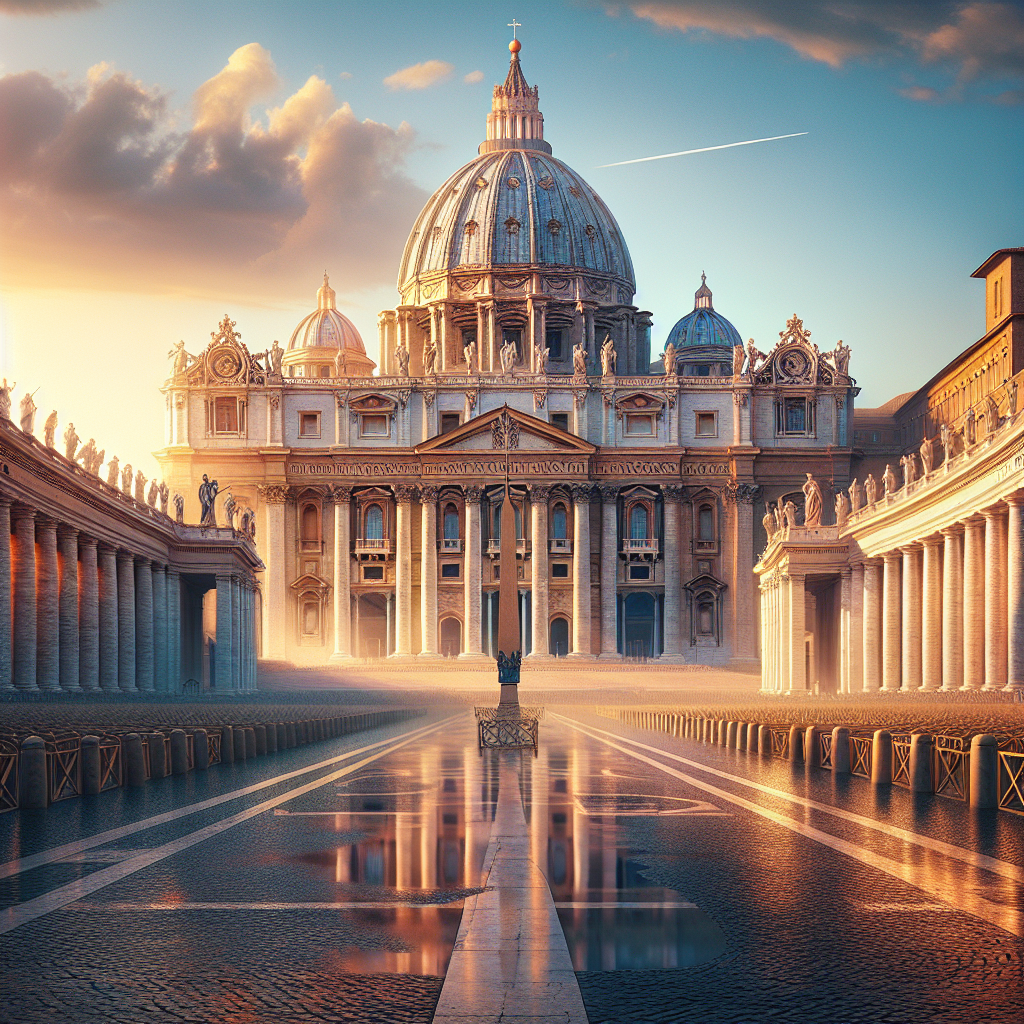
Designed by Gian Lorenzo Bernini between 1656 and 1667, Piazza San Pietro serves as the grand forecourt to 7. St. Peter’s Basilica – Vatican City. The sweeping ellipse, flanked by two massive colonnades of 284 Doric columns, symbolizes the “maternal arms” of the church embracing visitors from all corners of the globe. At its center stands the ancient Egyptian obelisk, relocated here in 1586, flanked by two elegant fountains that mirror each other in perfect symmetry.
Early mornings or late afternoons—around 8 AM or after 5 PM—are ideal for soaking in Bernini’s design without the hoards. You’ll often find visitors lingering on the travertine stones, tracing the starburst patterns that converge on the obelisk. If you time your visit during a papal audience on Wednesdays, you can witness crowds gathering near the central balcony, waiting for a blessing. Your senses will be filled with soft echoes of footsteps, the rustle of prayer cards, and the warm glow of Italian sunshine bouncing off the colonnade’s cream-colored marble. Don’t miss the subtle incline leading up to the basilica steps—a clever design to gently elevate newcomers toward the grandeur of the façade.
Marvels of Art and Architecture Inside the Basilica
Once inside the cool, expansive nave of 7. St. Peter’s Basilica – Vatican City, your eyes will be drawn to the ornate bronze baldachin, glittering altars, and chapels housing masterpieces from the Baroque and Renaissance periods. The floor’s intricate marble patterns guide you toward focal points like the Altar of the Chair of Saint Peter and the Chapel of the Blessed Sacrament. Each chapel tells a story in sumptuous detail: from the golden mosaics of the Confessio to the colorful lapis lazuli inlays that shimmer under strategic spotlights.
Look upward, and you’ll witness Michelangelo’s influence beyond the dome in decorative elements on the pendentives. Nearby, sculptural groupings by Bernini animate the space, their polished marble surfaces almost lifelike. Practical tip: in the afternoons, light floods from the right-hand clerestory windows, illuminating the bronze sculptures and giving them an almost celestial aura. Allow at least 45 minutes to meander through the interior, pausing at information plaques that explain the symbolism woven into every cornice, column, and fresco.
St. Peter’s Baldachin: A Glimpse of Baroque Splendor
Rising 29 meters above the papal altar, Bernini’s bronze baldachin is the visual centerpiece of the main nave. Commissioned by Pope Urban VIII and completed in 1634, the baldachin marks the spiritual site of Saint Peter’s tomb, located just beneath the high altar. Its spiraling Solomonic columns are embellished with bees—the heraldic symbol of the Barberini family, Urban VIII’s lineage—intertwined with gilded-leaf vines and angels.
Approach the baldachin and notice the subtle asymmetry: the left column leans slightly more than the right, countering the basilica’s inevitable settling over centuries. This intentional correction highlights Bernini’s engineering prowess. If you have a guided tour, your guide will often stand at the bronze railings to point out the tiny cherub faces hidden in the cornices. For photographers, the best vantage is from the third pew on the right; here, the morning light streams through the clerestory, casting ethereal highlights on the polished bronze.
The Pietà by Michelangelo: A Touchstone of Renaissance Art
Carved in Carrara marble when Michelangelo was only in his early twenties, the Pietà remains one of the most emotionally resonant sculptures of the Renaissance. Housed in the first chapel on the right as you enter, the piece portrays Mary cradling the dead body of Christ with astonishing tenderness and realism. Michelangelo’s signature finesse is evident in the delicate folds of Mary’s drapery and the anatomical precision of Christ’s lifeless limbs.
To protect this national treasure, the Pietà is encased behind bulletproof glass, but the protective barrier hardly dims its impact. Visitors often find themselves drawn into the serene expressions sculpted on Mary’s face, a testament to Michelangelo’s belief that beauty could convey spiritual truth. Allow 5–10 minutes here to soak in the details: the veins on Christ’s arms, the serene sorrow in Mary’s eyes, and the subtle suggestion of motion in her garments. Many travelers describe a hushed awe—an almost tactile sense of reverence—that lingers long after they move on to the next chapel.
Exploring the Vatican Grottoes: Where History Lies Beneath
Beneath the basilica’s marble floor extends a network of tombs and chapels known as the Vatican Grottoes. Accessible via a side staircase near the entrance, this subterranean complex houses the remains of 91 popes, including tombs of Innocent XI and Paul VI. St. Peter’s alleged burial site is marked by a golden sunflower on the Confessio floor above, but below, you can explore chapels dedicated to various saints and martyrs.
The grottoes are cool and dimly lit, creating an intimate atmosphere far removed from the bustling crowds above. Note the stone sarcophagi carved with intricate reliefs—a fusion of Christian iconography and early Christian art. A helpful guide map near the stairwell pinpoints each tomb, and you’ll often find guided tours limiting their group size to 15 people for a quieter experience. Plan at least 20 minutes for this descent into history, and bring a light jacket—the temperature hovers around 18 °C year-round.
Tips for a Memorable Visit to St. Peter’s Basilica
When planning your trip to 7. St. Peter’s Basilica – Vatican City, timing is everything. Arrive before 9 AM to breeze through security checks with minimal lines—especially outside high season (April–June and September–October). Dress respectfully: shoulders and knees must be covered, and avoid hats inside. Consider booking a skip-the-line ticket or guided tour in advance to save up to an hour of queue time.
Inside, rent an audio guide for about €7 to gain context on each chapel’s artwork. Keep your camera on silent mode and be mindful of pilgrims in prayer. Hydrate beforehand; no water fountains are permitted past security. If you want to climb the dome, purchase your ticket (€10 by stairs, €15 by elevator) as soon as you pass the main nave—you don’t want to backtrack. Lastly, explore nearby attractions like the Vatican Museums and the Sistine Chapel, only a 5-minute walk north, to round out your Vatican City experience.
Capturing the Essence: Photography Guide at the Basilica
Photographing in 7. St. Peter’s Basilica – Vatican City requires preparation. Use a wide-angle lens (16–35 mm) to capture the vast nave and soaring columns. Early morning light streams in from clerestory windows, illuminating golden mosaics and casting dramatic shadows—this is your golden hour inside the church. Set your ISO around 400–800 to balance clarity and low-light conditions, and shoot in RAW for post-production flexibility.
For the dome interior, position yourself on the circular walkway above the nave (requires separate ticket)—the concentric mosaics are best shot from this vantage point. At ground level, look for symmetry: place the baldachin in the center of your frame, using the central aisle as your leading line. Respect no-flash rules near the Pietà to preserve the marble’s subtle textures. Finally, don’t forget exterior shots: from the Piazza, zoom in on the façade’s inscriptions and the angels lining the balustrade. A polarizer filter can help saturate Rome’s blue skies and reduce glare on marble surfaces.
Conclusion: A Fusion of Faith, History, and Art at St. Peter’s Basilica
Visiting 7 St. Peter’s Basilica – Vatican City is more than a sightseeing stop; it’s an immersive journey through nearly two millennia of religious devotion and artistic achievement. Each step—from the sweeping colonnade of Piazza San Pietro to the hushed reverence of the grottoes—reveals layers of history you can almost touch.
Whether you’re marveling at Michelangelo’s dome, reflecting before the Pietà, or simply soaking in Bernini’s Baroque drama, the basilica leaves an indelible impression. Plan carefully, dress respectfully, and allow time for quiet moments of awe. In doing so, you’ll experience why this monumental church continues to captivate hearts and minds around the globe.